
Colony Ship Review
Fighting mutated frogs in space, one turn at a time

After discussing a very well-known game in my last post, this time I’m going to review a little-known gem: Colony Ship by Iron Tower Studio (ITS). ITS is a small indie studio that specializes in RPGs. They are chiefly known for their debut game “The Age of Decadence”.
Colony Ship was released in 2023 and is the studio’s most recent game. Unsurprisingly, it’s also an RPG, more precisely, an isometric, party-based one with a strong resemblance to Fallout. Naturally, that caught my interest, and I was in for a treat. Colony Ship was my game of the year 2023. Hence, it’s about time that it gets a full review here on Corerunner.
Setting
The game takes place on the titular colony ship, which has been on its mission to reach Proxima Centauri for generations. After a disastrous mutiny against the ship’s original leadership, the population has splintered into different factions, and no one has a clear idea on the state of the mission.
Our adventure starts in the pit - a sprawling heap of vacant cargo containers populated by those who couldn’t afford to stay in the nicer parts of the ship. An old friend has a hunch on where to get some valuable tech, and he wants us to check it out.
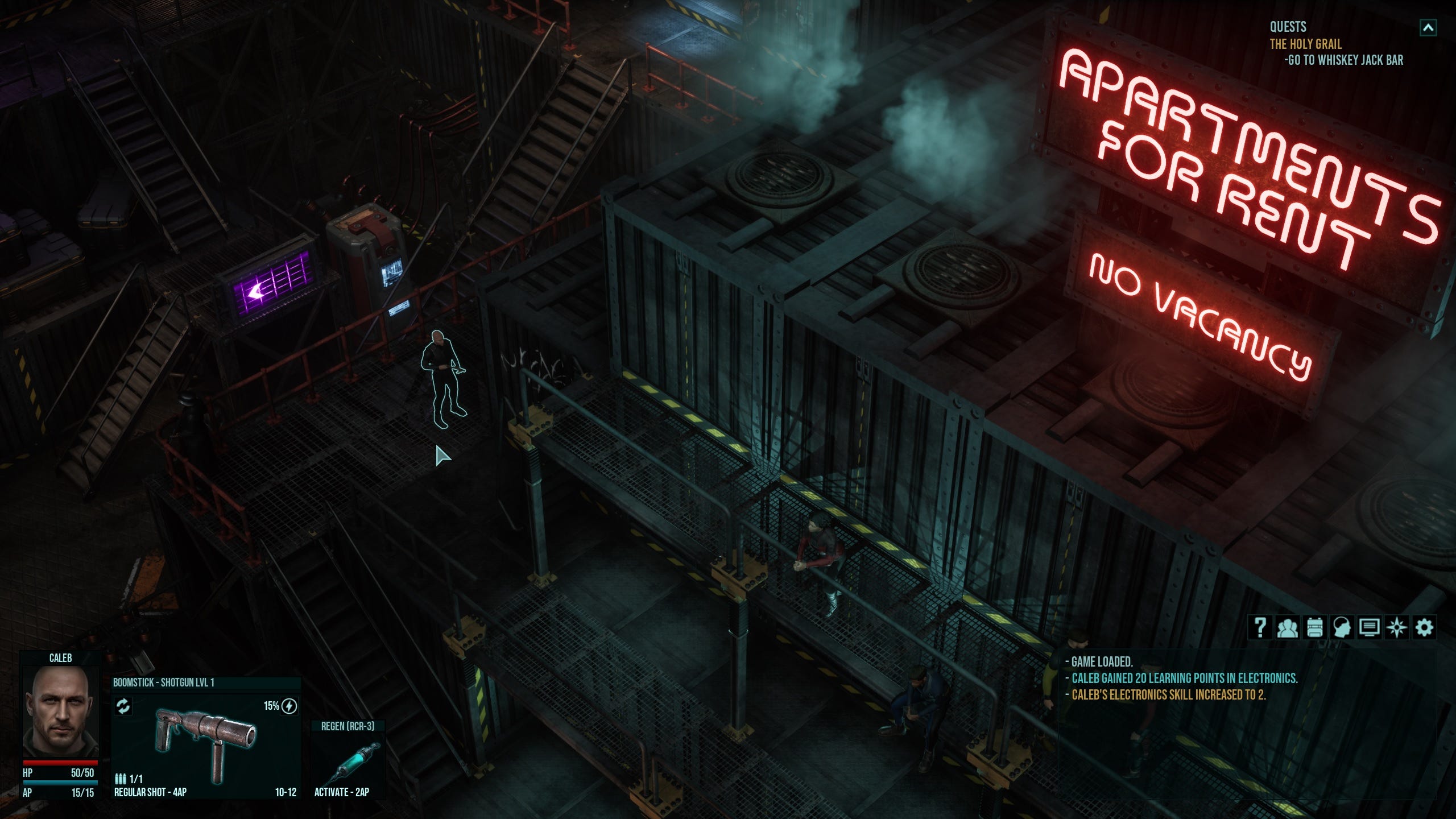
As a side effect of the mutiny, the ability to keep the ship maintained and to manufacture any kind of advanced tech has fallen drastically. This makes old tech very valuable, so naturally, we’re eager to take a look at the old armory our friend has pointed out. This is the start of our journey that leads us to 15 different locations.
Colony Ship isn’t an open-world game. Instead, we travel between locations on a map and can then explore the location’s sublevels. This is another similarity to Fallout and to the old BioWare games like Baldur’s Gate.
As we’re on a spaceship, many locations serve a specific purpose that impacts their shape. For example, the hydroponic area of the ship is naturally completely different from the engine bay. Some areas, like the pit, have been misappropriated as living space with varying degrees of success. Most of the locations are in some state of disrepair, with some being worse off than others.
I especially liked exploring the old mission control area that was devastated during the mutiny and hence abandoned. It’s now only filled with soldiers of fortune who rummage through the remains in the hope of finding some valuable tech. Exploring it and piecing together what exactly happened during the mutiny was very interesting.
Consequences
As mentioned, the mutiny has robbed the ship of any form of central control. As a result, the game is filled with warring factions. No matter what subarea of the ship we’re exploring, we should expect at least two competing factions who are eager to involve us in their struggle. We get our first taste of this before we even leave the first area.
As we’re frequently drawn into power struggles, we’re required to make decisions, and we have to live with the consequences. This even includes our character build, as we can miss a lot of game content entirely if we can’t pass the required skill checks. The game is merciless in that regard, and I salute ITS for having the courage to balance it like this.
Naturally, the game also has multiple endings, with some being much easier to obtain than others. Interestingly, the worst ending of the game is the hardest to unlock. Once we reach the ending, we also get to see some ending slides for each location of the game in a fashion very similar to Fallout. Depending on our actions in the game, we can drastically alter the fate of certain areas, including the one of the pit.
This sharp focus on consequences makes it very satisfying to finish Colony Ship multiple times, as it’s impossible to see all variants in a single playthrough. As the game also supports a wide array of valid character builds and playstyles, replaying it can be a lot of fun. It also helps that the game is only about 10 to 15 hours long and repeated playthroughs are much quicker.
Narrative
The story itself is only serviceable and centers around a very valuable piece of old tech that has the potential to dramatically alter the balance of power on the ship. This ties into the game’s love for consequences, as we can ultimately decide which faction gets control over the device. While this sounds very dramatic, the actual presentation of the story is rather plain. In fact, the main purpose of the story is to give us the reason to explore the different parts of the ship.
The writing itself is fine, albeit a bit depressing at times. The ship is a bleak place, and most of its inhabitants are surly, violent, and greedy. While there are no low points in the writing, there are also no clear high points that would elevate the full experience.
We get the chance to recruit various party members over the course of the game. Most of these have their own little storyline. These boil down to an additional quest or two that becomes active when we enter a certain location. Completing the storyline is optional, but doing so will improve our relationship with the party member, which in turn will slightly boost his combat prowess.
These storylines are nothing to write home about, but I like how they flesh out our companions a bit more. However, even with the quests in place, no party member is particularly interesting. The game shines in other areas, for example, in its character system.
Character System
Colony Ships’ character system is quite different from genre standards. Things start familiar enough during the character creation, where we define our starting values (between four and ten) for six attributes: strength, constitution, dexterity, perception, intelligence, and charisma. These attributes behave similarly to the ones of the Fallout series, and like in Fallout, they don’t increase during level ups.
In fact, our only way to increase them is by installing implants. However, we first have to find these implants, and we can only install a limited amount of them depending on our constitution. We can buy implants, but extracting them from corpses via the biotech skill is much more economical.
Speaking of skills: the game has 18 of them, and we increase them chiefly by using them. The game is littered with actions that need a certain level of a certain skill to succeed. We need to start with the simple challenges and work our way up until we’re experienced enough to tackle the hard ones.
The implication of this is that there is little reason to specialize a character. We don’t need to spread out our skills over our party. It’s perfectly reasonable to have one character who’s good at almost everything because we don’t need to invest points into skills to raise them. As long as we use the skills, they will grow.
That said, we can tag a limited number of skills per character to raise their starting level and to make increasing them easier. Hence, it can make sense to always use a character with a tagged skill for certain actions. Fortunately, the game allows us to set a party member as default for each skill so that we don’t need to manage this manually.
As skills only grow with usage, the skills we use less will remain underdeveloped. This leads to interesting trade-off decisions. For example, if we primarily solve conflicts by fighting, our persuasion skill will most likely be underdeveloped, which can bite us when we absolutely have to pass such a check. As there are some very challenging (but usually optional) skill checks in the game, we might have to carefully develop certain key skills throughout our playthrough.
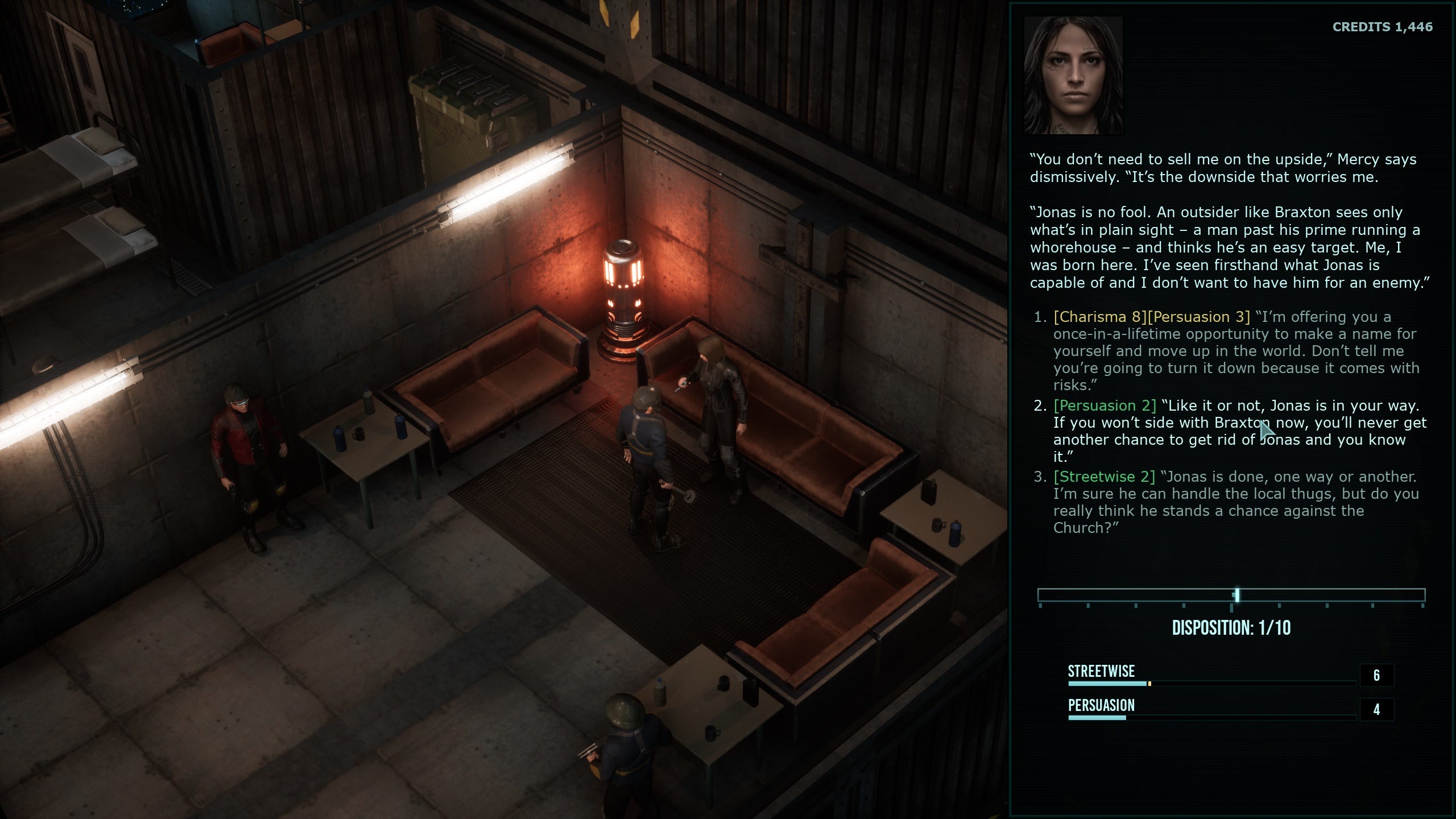
I already mentioned that neither our attributes nor our skill levels increase on level-up. However, each level up grants us an additional feat. Feats are the last piece of the character system and the most important one. Our selected feats chiefly determine how our character will play like. There’s a wide variety of feats, including combat, stealth, and skill-related ones.
Some feats can’t be picked during level-up. Instead, they get unlocked during playing. For example, we gain the “Frog Hunter” feat if we manage to repair a broke computer and access the research data on it. Unsurprisingly, this feat makes us more effective at fighting the giant mutated frogs that populate certain areas of the ships.
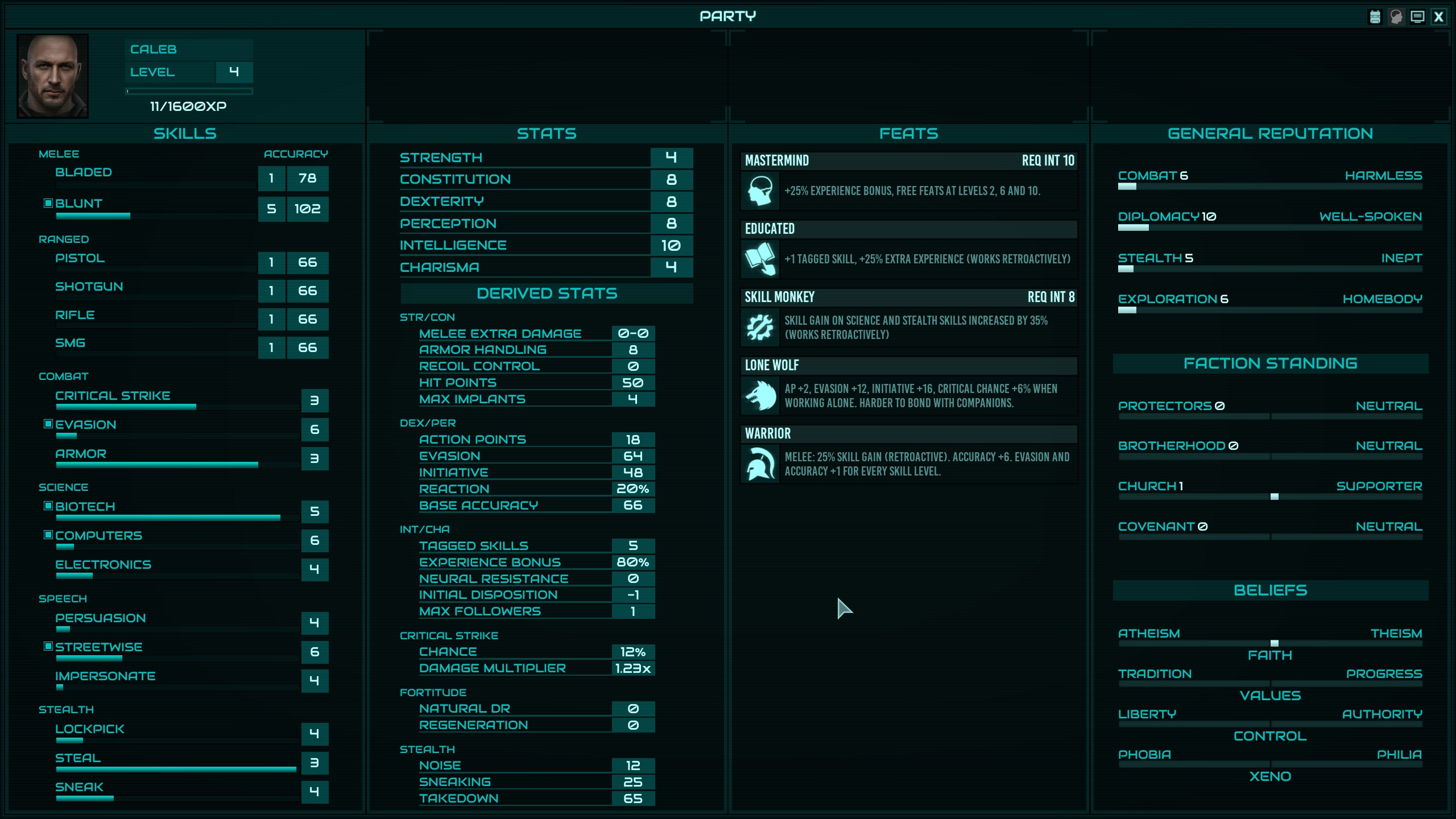
There are also seven heroic feats that we’re only allowed to pick during character creation. As a result, these are limited to one per playthrough. Six out of these are linked to a certain attribute and require an attribute value of 10 to unlock. For example, intelligence 10 grants us access to the Mastermind feat that blesses us with a 25% experience bonus and an extra feat on levels 2, 6, and 10.
Our choice of a heroic feat has a big impact on our playstyle. It’s probably the biggest differentiating factor between different builds. Colony Ship’s character system is a big reason why the game has such a satisfying character progression.
Character Progression
The key factor in the game’s character progression is the idea of increasing skill levels through usage. We frequently explore areas and get teased by all the things we cannot get to because we lack the necessary skill level. Once we finally reach the needed skill level, which might only happen many hours later, and can finally access that tantalizing chest, the triumph is incredibly sweet. This system also gives a great incentive to explore, as every room might contain the chance to use some skill and thereby increase it.


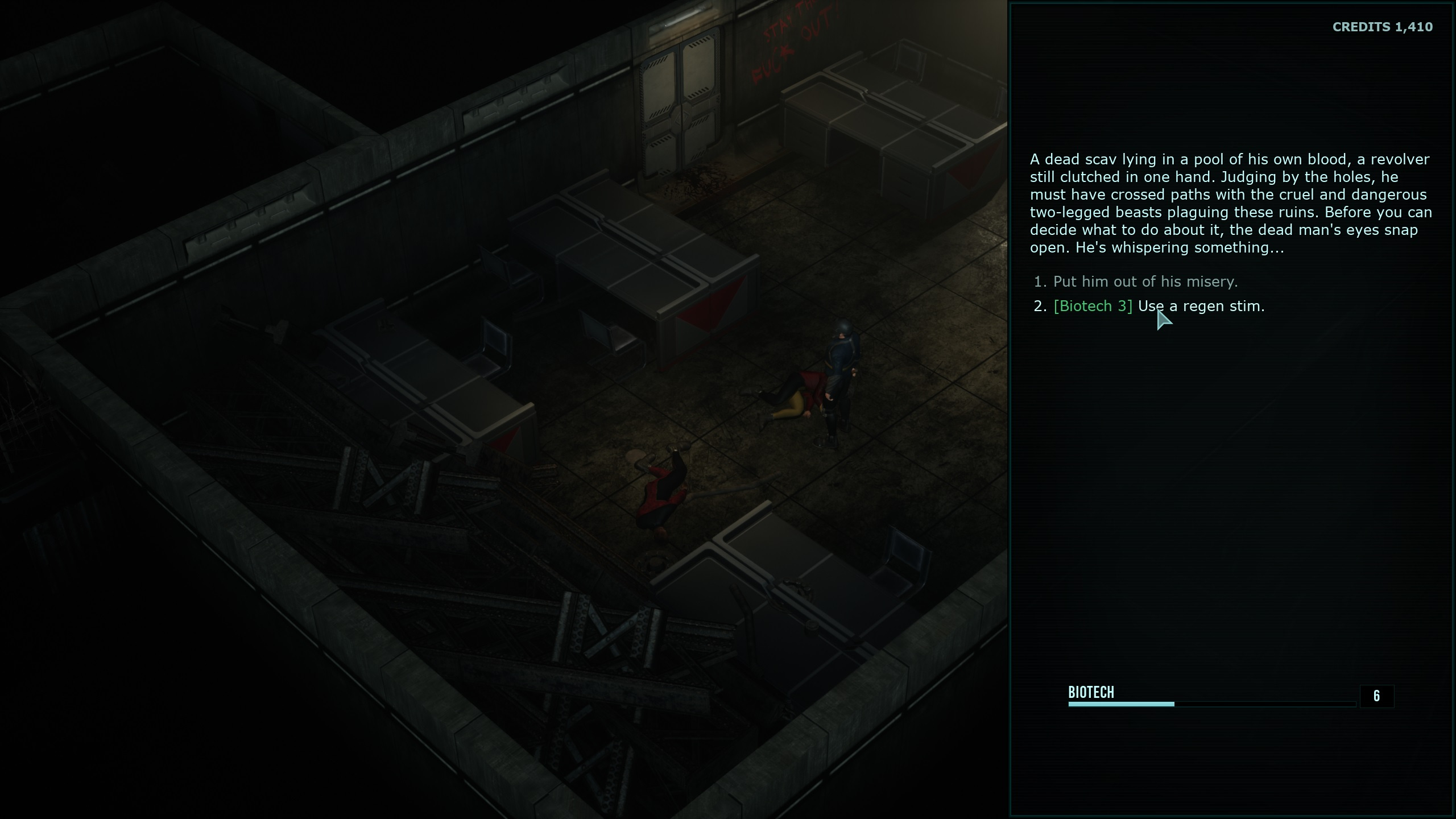
When we manage to access some previously locked room, we get rewarded with loot. The game’s loot system is rather uninspired. There are many variants of very similar armor pieces that only differ slightly. Hence, it doesn’t feel like a great reward to find armor. I prefer a more coarse-grained system, similar to how it’s done in Fallout and Gothic, as it is more impactful.
However, there is some exciting loot. Energy weapons and their corresponding ammunition are always a great find. These weapons are rare and exceptionally powerful. They are essential against certain types of enemies, but their ammunition is so rare that we have to ration it throughout the game.
Implants also make a big difference, as they are the only way to increase our attributes. We want everyone in our party to have the maximum number of implants installed, so we have a huge demand for them. Installing a new implant makes an immediate and noticeable difference, so they are a great form of progression.
The feats we gain on level-up vary in terms of impact. Some are great upgrades that we’re looking forward to, and some are just okay. In general, level ups feel less important than getting our skills to the highest possible level. Given that characters in the game only reach somewhere between 9 and 11 in a playthrough, I think that the impact of a level up could’ve been greater.
To sum up, the character progressing is great and chiefly driven by the skill system. For me, RPGs are about progression, so Colony Ship is doing everything right in that regard. In addition to the outstanding progression system, the game also features a great combat system.
Combat
Even though the game allows us to completely skip combat if we’re so inclined, its combat system is very deep. In Colony Ship combat is turn-based. Characters have a limited amount of action points for each turn and can spend the points on movement, attacking, using gadgets, accessing the inventory, and using various combat items.
Gadgets are defensive items that we can trigger at any point during combat. There are three kinds of gadgets in the game: energy shield, distortion field, and cloaking field. The energy shield reduces any incoming damage but can only absorb a certain amount before it’s depleted. The distortion field makes our character harder to hit and damages enemies if they attack us in close combat. The cloaking field makes our character briefly invisible, which allows us to attack enemies without fearing any retribution. It’s also very helpful during sneaking sections.
While the energy shield is active until depleted, the cloaking field and the distortion field are only active for a couple of turns. We can upgrade the gadgets to extend both their effectiveness and durability. However, correct timing of any gadget activity remains key for difficult fights.
Timing is also essential when using two other key factors during combat: stimulants and grenades. Stimulants can be injected to grant a temporary boost. For example, the aggro stimulant makes us much more dangerous in close combat. However, once it wears off, we suffer a steep debuff until the end of the combat. Hence, it’s very important to time this correctly. Ideally, we want to finish all or most of the fight before the stimulant expires.
Grenades provide temporary debuffs in a certain area when thrown. For example, smoke grenades dramatically reduce the accuracy of ranged weapons in an area. Grenades are extremely helpful and hence quite valuable. As vendor inventory is limited, we have to be careful not to waste them. This is especially true for the rare grenades like the stasis grenade that freezes enemies for a couple of turns. We should only use these if we absolutely have to.
In addition to deciding on our gadget, stimulant, and grenade use, we also have decided on how to deal damage to our enemies. Here, the game offers us a lot of options that can make a difference in a close fight. We can choose between different styles of attacks, with some costing more action points than others. For example, we might want to aim at an enemy’s weak spot to increase our chance to hit even though it costs more action points to do it. We can also do a quick attack with a lower chance to hit for a reduced cost in action points.
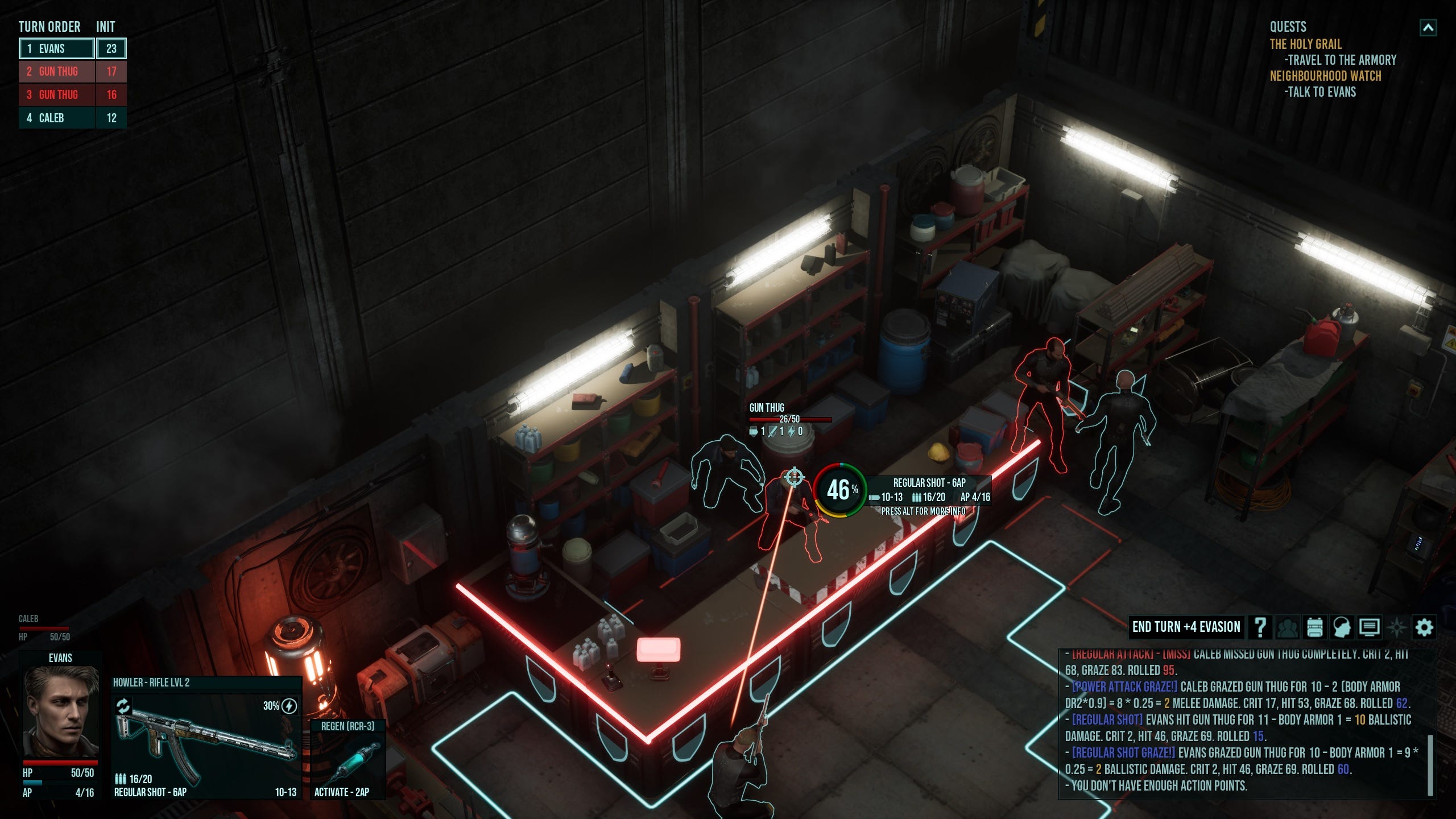
Some weapons have additional styles of attacks like burst modes that we can use as well. Picking the best possible attack for a situation is crucial if we want to make the most out of our limited amount of action points. Some aimed attacks also provide temporary debuffs to enemies, which can also be very helpful.
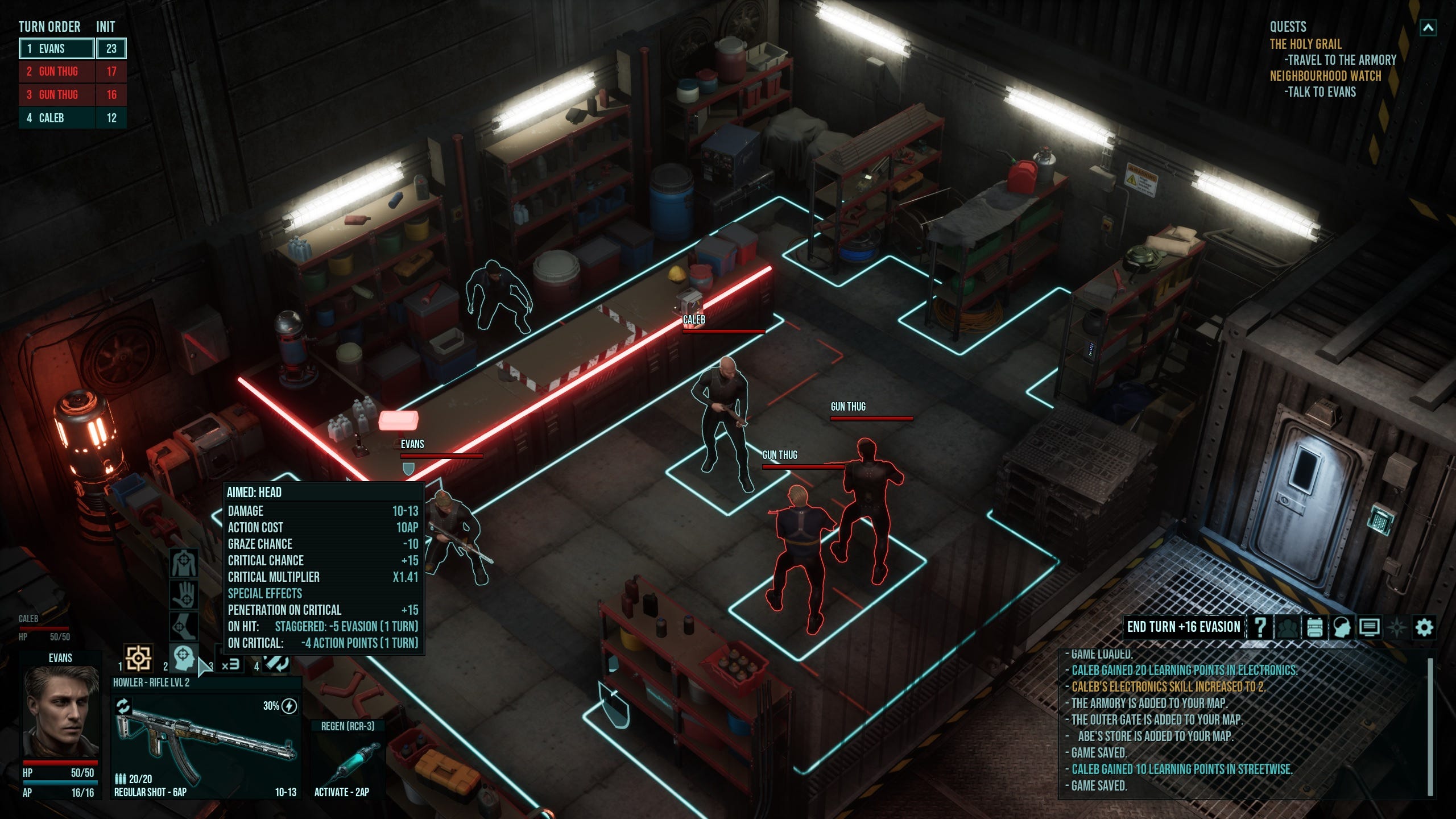
Naturally, we also have to make sure that our characters are placed correctly. Melee fighters need to be close to the enemy, while ranged ones should be more distant. Every weapon type has an ideal distance, and we need to keep this in mind if we want to reliably hit enemies. The game also includes reaction attacks that will get triggered if we cross an enemy’s path. Fortunately, this is clearly indicated by the game, and not every reaction attack will result in a hit. In ranged combat, we also need to make sure that we have a clear line of sight.
Before combat starts, we get the chance to reposition our characters in a small area. This is helpful to get characters into cover and to place melee characters as closely to the enemies as possible. We also have the chance to directly trigger a gadget here. This can make sense if our character is very late in the turn order and we fear that he gets overwhelmed without the gadget. The downside of this is that we start with fewer action points in our first turn and that it might mess with our gadget timing.
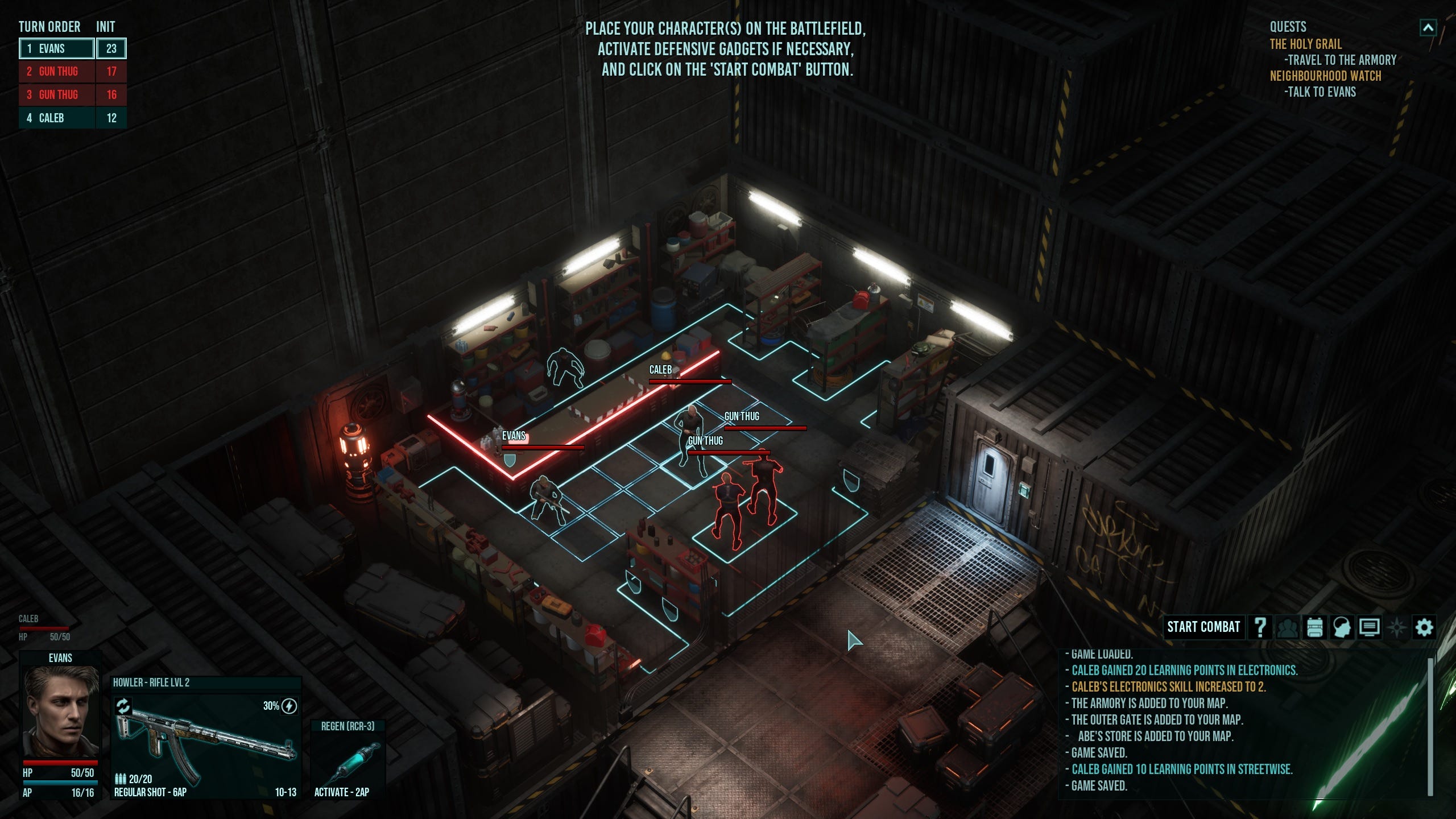
It’s important to understand the nuances of the combat system, as we mostly fight other humans who have the same tricks up their sleeve as we do. They will use gadgets, stimulants, grenades, etc. effectively, and if we don’t understand what’s happening, we will make poor decisions.
All of this might sound overwhelming, but the game allows us to customize our experience a lot. Combat becomes less difficult the more party members we have. In addition, the vast majority of hard fights in the game are actually optional. In fact, with the right character build, all fights are optional.
So, if we want to have an easy time in combat, we can just play a full party build and roll through most fights without understanding the combat system in detail as our party does the heavily lifting. In fact, I only truly understood the combat system once I did a solo run where I was forced to dig deep. The game is very challenging when played solo, and we will have to try many fights multiple times to find the right strategy.
When playing with a party, we need to keep in mind that the game has a perma-death system. If a character falls in combat, a death timer starts. Every round, this timer decreases by one. If it reaches zero, the party member is gone forever. Coming close to dying also grants extra feats to the character: he becomes harder to kill but loses some max hp.
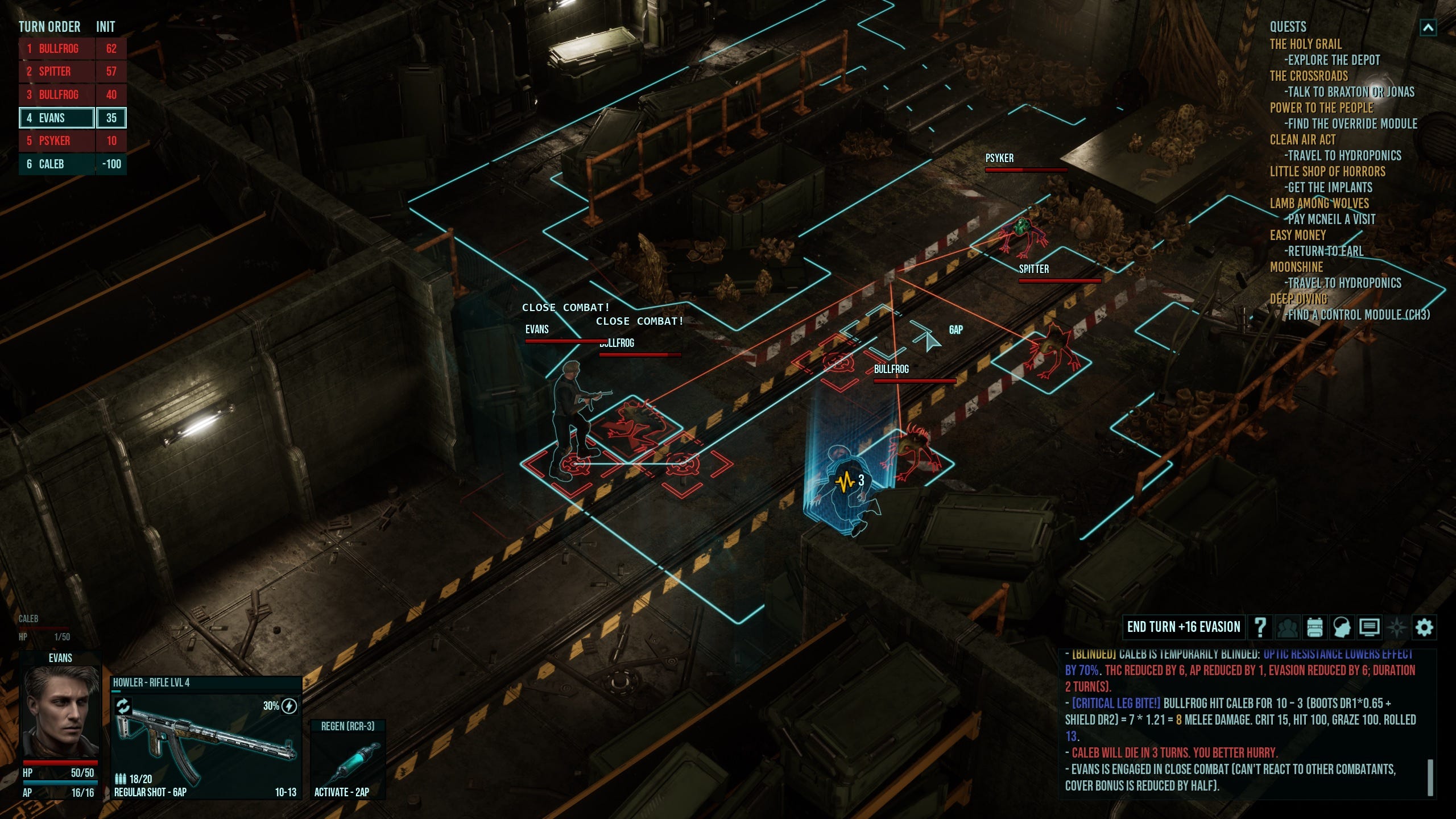
In sum, Colony Ship’s combat system is fantastic and one of the best features of the game. While I like that the game allows us to skip combat completely, I’d highly recommend playing a combat-heavy build. I’ve done a run without any combat, and it was by far the most boring one.
Flaws
While I love the game, I don’t want to hype it up to a level it can’t deliver. This is a niche game done by a small team, and the budget constraints show. The game is heavily frontloaded, and later areas are obviously unfinished. There’s no voice acting, animations are crude, sound is lifeless, and the graphics are passable at best. Interestingly, the game is also quite demanding and suffers from occasional frame drops. I guess that’s just Unreal Engine being Unreal Engine.
The controls are also quite clunky, and the game does an incredibly poor job at explaining itself at times. The itemization is bland: It’s hard to get excited about the next dozens of shoddy boots, which fetch ten credits each. As mentioned, the story is nothing special either.
In terms of quest design, the game sticks to the basics. Most quests are simple fetch, kill, and talk quests. However, most of them can be solved in at least two ways to accommodate different playstyles, which is very cool. I’d have liked some more inspired quest design, as very few quests are memorable. That said, the status quo is perfectly serviceable, albeit nothing special.
However, even despite these flaws, I’ve finished the game four times by now, and I rarely replay games. There is just something to Colony Ship that just clicks for me. If you like old-school RPGs, like I do, then it will click for you as well.
Conclusion
Colony Ship is a fantastic RPG notable for its brilliant character progression, deep combat, and dedication to consequences. If you have any love for RPGs at all and can tolerate a lack of polish, then you must check it out.
While the game was well received and sold well for a game by ITS, the studio still announced that they didn’t make enough money to realize their dreams for a direct successor. Instead, they will focus on a smaller project in a new setting. The lack of commercial success for the game is a shame, and I hope that sales pick up at some point in the future so that ITS can enjoy the success it deserves.
Thanks for reading. Please consider subscribing to the Substack. Also, please share it with a friend. You can do both with these handy buttons below.
I've been meaning to get around to Age of Decadence and Dungeon Rats for a while now, but this sounds even more my speed. What was your impression of those first two games, if you played them?
“There is just something to Colony Ship that just clicks for me. If you like old-school RPGs, like I do, then it will click for you as well.”
Seconded - there’s something here. I really enjoyed this game.
For people considering it: first, it’s great, worth your time, go get it. Second, keep in mind it isn’t a traditional D&D type game - outside of combat, there’s not a lot of RNG. I don’t agree that you can be a jack of all trades here - this is more that once you’ve picked a speciality (you’re stealthy, you’re persuasive, whatever) that’s probably going to be your jam for the game. If you played Age of Decadence it’s that - the rewards for diversifying aren’t really there unless you have foreknowledge of the game. Pick a build and stick with it.
But it’s set in a terrific universe. Like Corerunner said the quests are particularly memorable, but the environment and history really are. Totally worth it.