
Fallout Review
Post-apocalyptic retro-futurism at its finest

After writing only about action games so far, it’s about time that I write about a role-playing game (RPG). The RPG genre is also close to my heart, and choosing a game for this post was quite difficult, as I like many. In the end, I settled for a highly flawed game that’s very important nevertheless: Fallout.
Fallout is a 2D RPG with turn-based combat released in 1997. It was developed by Interplay. While the game is often described as isometric, this isn’t correct, as the game actually uses a cavalier oblique projection. As a side note, this is also the reason why characters sometimes move in a zigzag.
Fallout is an unusual game, both for its time and for today. The most striking unusual element is clearly its setting: a post-apocalyptic, retro-futuristic California.
Setting
The events of the first Fallout take place in the year 2161, almost a hundred years after the world was nearly destroyed by a devastating nuclear war between the USA and China. When the war broke out, some Americans were able to take shelter in large vaults.
Our protagonist is a descendant of such vault dwellers. His vault, Vault 13, suffers a critical failure in its water purification system. As a result, the vault is forced to send someone into the wasteland for the first time since the bombs fell.
Our mission is to visit another vault, Vault 15, that is located to the west and get a replacement water chip from them. That sounds easy enough on paper, but nobody really knows what’s waiting for us outside of the vault.
As mentioned, Fallout is not only post-apocalyptic but also retro-futuristic. Fallout’s timeline diverged from ours in the 1950s. Hence, its world looks like people in the 1950s imagined the future. As a result, the car wrecks we find in the wasteland look a lot like cars from the 1950s.
Also, all electronics in the game are clearly powered by vacuum tubes rather than by microchips. That doesn’t mean that there’s no futuristic tech in the game. There are robots, energy weapons, power armor, and nuclear-powered cars. The futuristic tech is just based on what was considered the future in the 1950s, e.g., nuclear power.
Even today, the retro-futuristic vibe of the game feels very fresh and interesting. In 1997, it was completely groundbreaking. While the post-nuclear-war setting was already established in video games, for example, by Wasteland, which directly inspired Fallout, the combination of retro-futurism and post-apocalypse was brand-new.
It’s also important to note that the original Fallout has a very dark tone. This is made clear already in the game’s intro, where two soldiers execute a bound captive before waving cheerfully into the camera. The game is very bloody and unapologetically features themes like slavery and cannibalism.
There is close to no comic relief in the first game, with the exception of some snarky remarks our protagonist can make in certain dialogues and some pop-culture references found mostly in random encounters. The dark tone of the first game was too much for some countries. For example, both the British and the German versions of the game were censored as a result.
In addition to the unusual and captivating setting, Fallout also has an interesting character system.
Character System
Fallout’s character system is classless and skill-based. It is heavily influenced by GURPS. In fact, originally the game should have used GURPS, but the licensing deal fell through. So, Interplay quickly invented their own system called SPECIAL. It’s named after the first letter of the seven primary statistics (strength, perception, endurance, charisma, intelligence, agility, and luck).
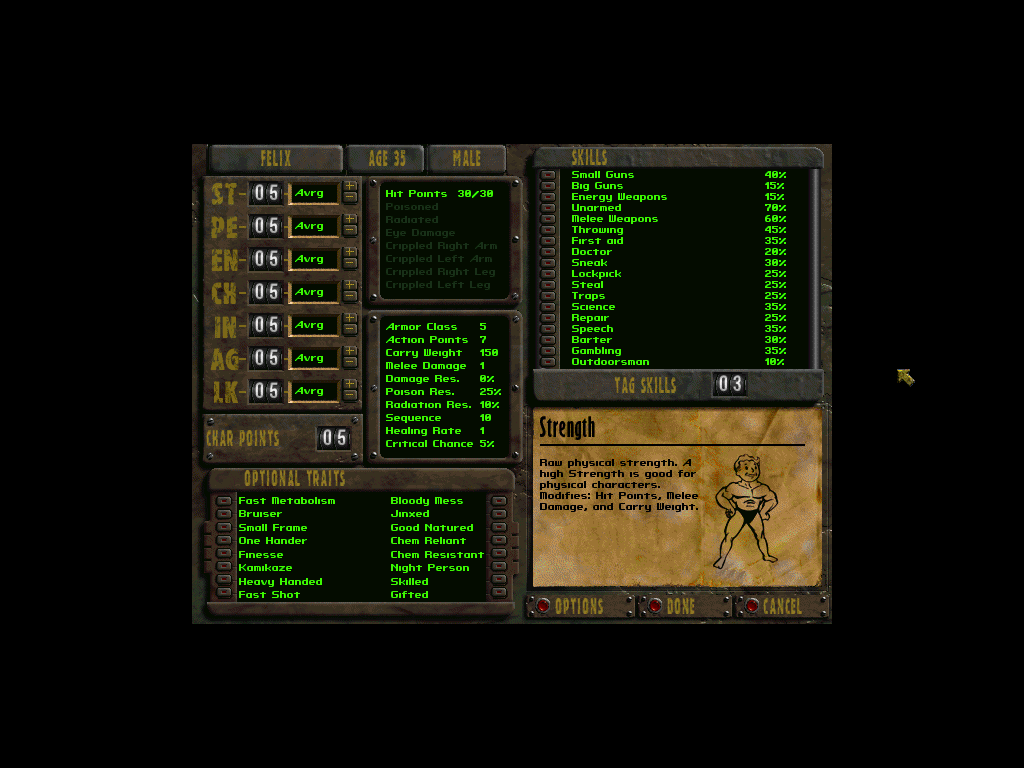
Each of these seven primary statistics has a value between one and ten. The character creation in SPECIAL is rather straightforward. We start with a value of five in each statistic and have five character points to spend on improving them. We can also reduce the value of a statistic to gain more character points. As the primary statistics don’t increase on level-ups, our initial choice is very important.
After setting our primary statistics, our next step is to pick two traits out of a list of sixteen. This is optional but highly recommended. Each trait has an advantage and a disadvantage. For example, the “Finesse” trait increases our critical chance by 10% but reduces our damage by 30%.
Some traits can significantly change our gameplay experience, while others are negligible or even purely cosmetic. Similar to the primary statistics, traits are unaffected by level ups. We only pick them at the start of the game.
Last, we have to spend our skill points. Fallout features 18 different skills; some are active (e.g., “Lockpicking”), and others are passive (e.g., “Barter”). Each skill has a different starting level depending on our character’s primary statistics and a maximum level of 200%.
We can tag three skills, which grants an initial boost and doubles the effectiveness of any spent skill point. After we have invested all our initial skill points, we can further raise our skills by leveling up, which will grant us further skill points, and by reading certain books.
The usefulness of the skills in Fallout varies greatly. Weapon skills are critically important to be competent in combat, but it’s our choice in which we want to invest. However, investing points in something niche like “Throwing Weapons” is a very bad idea. Other skills like “Speech” and “Lockpicking” aren’t essential but open up additional ways to solve quests.
For example, at one point of the game, we are asked to repair a water pump. This requires a high enough “Repair” skill level. This quest isn’t mandatory, but not repairing the pump has dire consequences for the inhabitants of this particular town. Speech is another highly useful skill that opens up non-violent solutions for a lot of quests. In fact, it’s even possible to finish the game without killing anybody. Long story short, skills are very important in Fallout.
Even though they are not part of the initial character creation, there’s one more element in Fallout’s RPG system that I need to mention: perks. Perks are acquired every three levels (four if we picked the “Skilled” trait). They offer various benefits from combat to dialogue and exploration improvements.
As a result, the power level of these perks varies greatly. Some of the later perks are very powerful while the ones available on level three are highly underwhelming. All in all, I think that the perk system is just okay. I don’t think that SPECIAL would be worse if the perks were removed.
As we can see, Fallout’s character system has little in common with something like Dungeons and Dragons. I also like that we focus on a single character rather than creating a full party.
While total control over your party member’s stats is nice, I feel that it stretches out the character creation too much. After all, we want to play the game rather than fiddling with the intricacies of the character system.
Gameplay
Now that we know the setting and have created a character, it’s time to explore what we actually do in Fallout. As mentioned, it’s a turn-based RPG, so we explore the game world and interact with people and objects in real-time while fighting battles turn-based.
The game grants us a lot of freedom to tailor the gameplay to our needs. If we don’t like the combat system, we can create a sneaky and smooth-talking character who can avoid most fights. If we really enjoy fighting, we’re free to attack everyone in the game world and suffer the consequences. We’re free to play the game like we want.
Fallout is a nonlinear game. We can decide on our own what location we want to visit in which order. When we leave the vault, we’re given a starting point for our search, but we can also completely ignore it and just explore the world map on our own.
This freedom combined with the lack of any gatekeeping allows for experienced players to finish the game very quickly. For reference, speedrunners can comfortably finish the game in less than 10 minutes. While I don’t think that this is a very enjoyable way to play the game, it’s very cool that it’s possible at all.
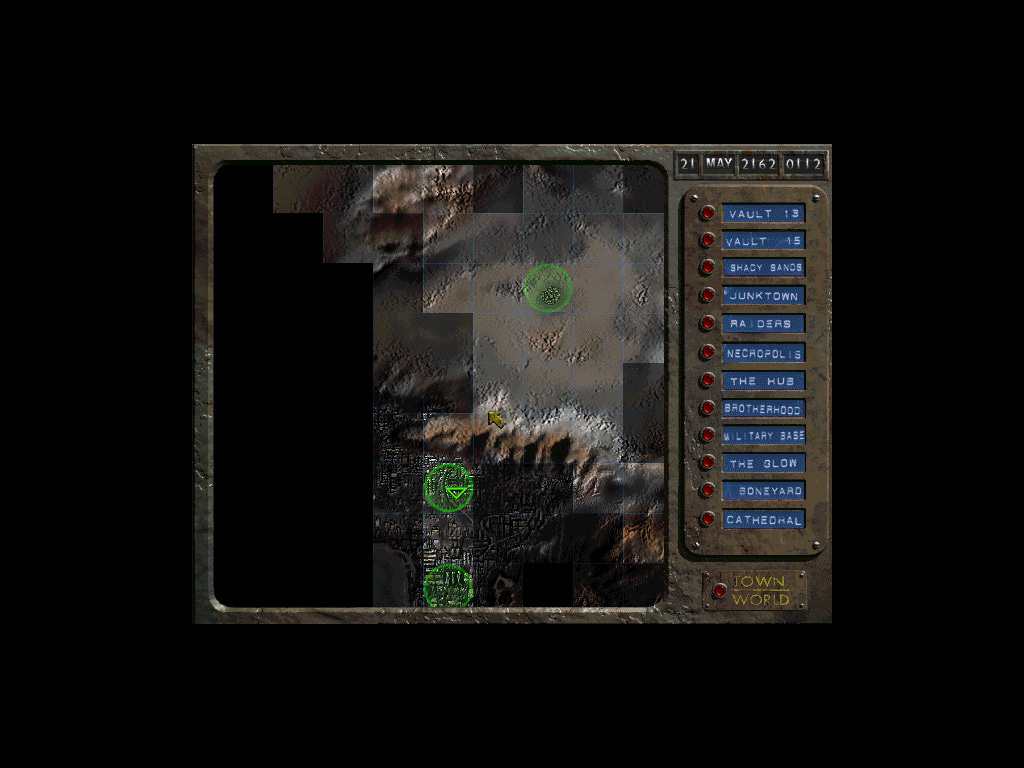
One side effect of this non-linearity is that we can venture into endgame areas way too early. As the game isn’t level-scaled (thank God), this means that we might end up in impossible-to-win fights. In that case, the best solution is to just leave and to explore a different area. After all, we can always come back at a later point in time when we’re stronger and get our revenge.
Even when we follow the “correct” order, combat in Fallout can be quite challenging unless we exactly know what we’re doing. As a result, the character progression in Fallout is incredibly rewarding. It’s mostly item-based, with a particular focus on improved armor.
Even just getting our very first armor (a stylish leather jacket) makes a big difference. As items have no level restrictions, we can also get very powerful early on if we manage to get our hands on some advanced armor. However, that requires in-depth knowledge of the game and the ability to dodge the high-level enemies watching over these items.
By contrast, the skill upgrades we gain at level ups are not quite as important. Increasing our weapon skills to a certain level is important for a decent chance to hit, but it’s very easy to reach a sufficient level of competency. In the end, there is a manageable difference between an “Energy Weapon” level of say 90% versus a level of 120%.
However, there are some very powerful mid- to late-game perks that do make a big difference (for example, “Bonus Rate of Fire”). So, level ups are welcome but not that big of a deal. As I’ve mentioned combat already in context of the character progression, I need to explain Fallout’s combat as well.
Combat
Combat plays a big role in Fallout (unless we opt for a non-combat run). Despite various harmful critters, most of our enemies will be other humans or at least humanoids.
The game allows us to attack anyone at will. This includes quest-givers and other important NPCs, including children. Killing a child is penalized by the game, but the mere presence of this possibility was so unacceptable to the European morals enforcers that all children were removed from the European versions of Fallout. In fact, even the GOG and Steam versions of the game are censored and contain no children.
As soon as we enter combat, the game switches into turn-based mode. Each participant has a certain number of action points per turn that can be used for either movement, attacks, skill or item usage, in any order or combination. This makes the combat easy to understand and very flexible.
In addition to regular attacks, we can also use aimed attacks. These cost one more action point but can be very effective. When executing an aimed attack, we have to select a target. For example, we might want to hit the enemy in the head. Our chance to hit is reduced the smaller the target is. Hence, we need quite a high level in the relevant combat skill to hit the eyes of the enemies.
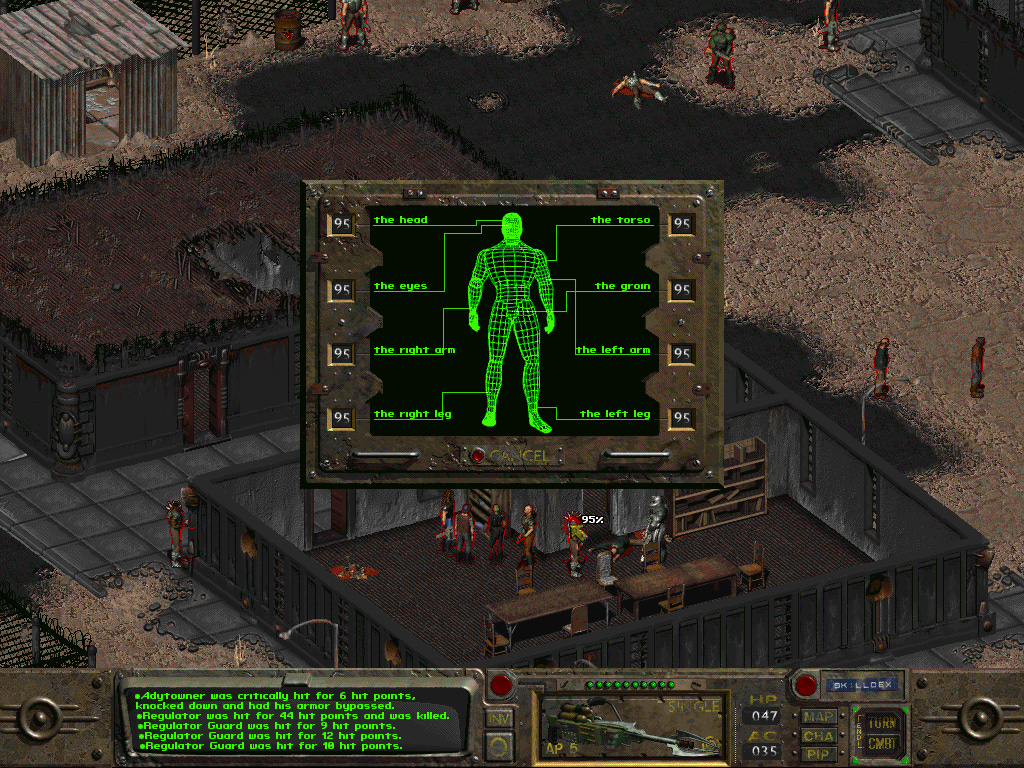
Aimed shots have special effects on critical hits. A critical hit to the head, for example, will knock an enemy out, instantly removing him from the fight. We can also reach incredibly high damage numbers when we’re achieving a critical hit to the eyes with the right character build.
It’s not uncommon to do more than 100 damage with a single such critical. For reference, the end boss of the game has 500 hit points. Targeted shots can also be helpful to bypass the enemy’s armor. For example, we’re given the explicit advice to target the eyes when fighting the deathclaw enemy type.
When talking about critical hits, it’s also important to mention that our enemies can score critical hits against us as well with the same devastating effects. In addition, there are also critical failures that can happen to both us and our enemies. These failures lead to embarrassing events like losing our next turn or hurting ourselves. As we can see, chance can play a big role in Fallout’s combat, especially in close fights.
A downside of the turn-based nature of the combat system is that fights with a lot of enemies can take quite a while. Some enemies are quite tanky, so the number of fight participants will drop only slowly. To speed things up, I recommend setting the combat speed to maximum and setting the combat log to “brief” once you’re familiar with the combat system. This will save you a lot of time in the long run.
Party Members
To increase our chances in combat, we can also recruit party members. There are a total of four companions in Fallout that we can recruit through the course of the game. There’s no party limit, so nothing prevents us from having all of them in our party at the same time. However, party control is limited at best.
We cannot control our party members at all during combat, so they are free to do whatever they like. Often, this is not the best course of action. It’s especially annoying that our party members make no attempts to prevent friendly fire. They will happily shoot at an enemy even if a teammate is in the line of fire. Often, this results in them accidentally hitting that teammate instead of the enemy.
This problem is made worse if we give them a weapon with burst mode. In burst mode multiple bullets are fired in a single action with dramatically lowered accuracy. Everything in a cone-shaped area might be hit by some of the burst shots. Bursts can do a lot of damage but should only be done at very close range and at an angle that spares any party members.
Naturally, our party members don’t care about any of that and just happily spray away when they feel like it. As a result, it’s not uncommon to get killed by friendly fire in Fallout. This problem can get reduced by not handing any party member a weapon with burst mode, but it cannot be avoided completely.
Another frustration with party members in Fallout is that they don’t level up and cannot equip better armor. This dramatically limits their usefulness in the late game, as good armor is essential to not die immediately when fighting well-equipped enemies.
Fortunately, we can give them better weapons, but this feature is also undercooked, as our party members barter with us like regular NPCs. This means that when we give them an item and want it back at a later point in time, we need to give them something of equivalent value. Hence, we cannot use our party members as mules to carry surplus items.
There is one last problem with using party members in Fallout: we cannot push them away. As a result, we can get trapped in a small room if our party members decide to block the door. Naturally, the chance of this happening increases the more party members we have. If we’re very unlucky, we can end up in a situation where we have to reload. This problem was solved in Fallout 2, which added a dedicated button to push party members and other NPCs away.
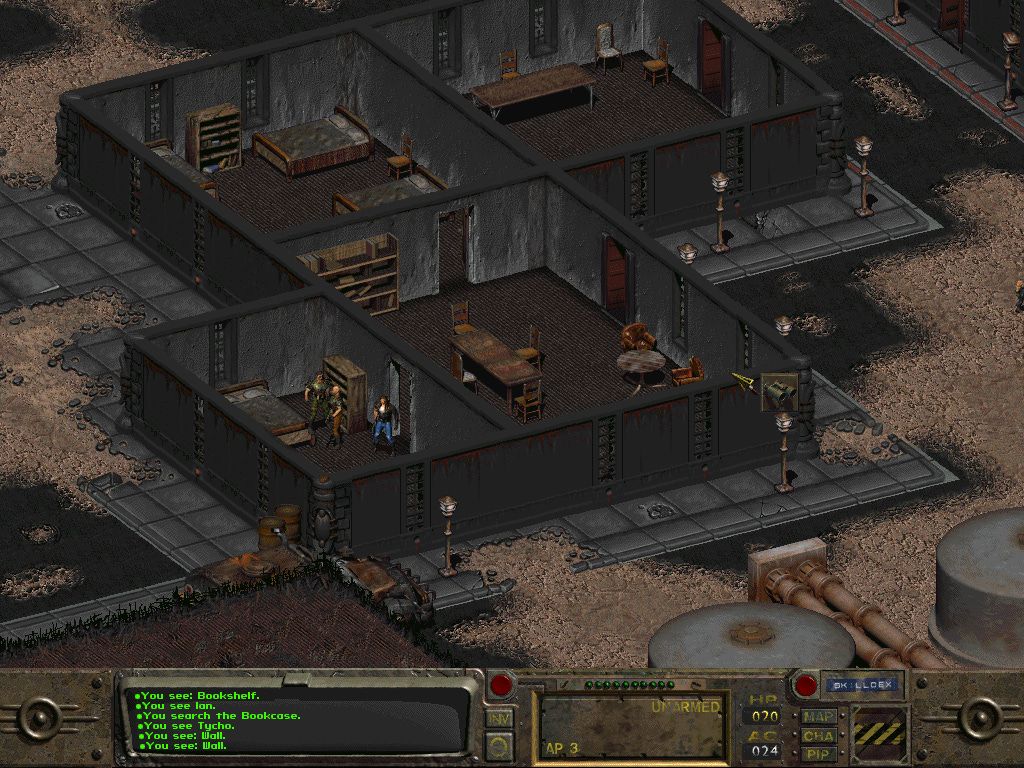
All in all, party members in Fallout can be useful in the early and mid-game but become a liability in the endgame. Hence, I usually leave them behind after a certain point or play the game completely solo.
Quests
As Fallout is an RPG, it’s not very surprising that it also contains quests. Most quests have multiple solutions, so we can choose whatever tickles our fancy. For example, we’re offered a hitman job by a shady casino owner in The Hub. We’re now free to do the hit or to report the owner to the police.
If we choose the latter, we can then decide to take part in the arrest (which means combat) for a higher reward or to let the police handle it. If we take part in the fight, we get a better reward. Naturally, we’re also free to completely ignore the quest and continue with our main mission.
Some quests require us to be at the right place in the right time. For example, in Junktown we can rent a hotel room to pass the night (and heal some more hit points compared to sleeping in the streets). If we do, we get woken up in the middle of the night and are asked to resolve a hostage situation in one of the neighboring rooms.
We can do this by talking the hostage taker out of it, killing him (hopefully before he kills the hostage), or by sneaking. If we never spend the night in the hotel, we will miss the quest completely. There are no highly visible quest indicators in the game.
The total number of quests per location in Fallout is quite low. This is a result of the game’s difficult development process. Sadly, some quests are blatantly unfinished. For example, there’s a street food vendor in The Hub who uses a highly questionable special ingredient. Once we learn about this, we can blackmail the vendor for a share of the profits. However, reporting the vendor to the police was never implemented even though we can explicitly threaten him with this in the dialogue. Naturally, this is widely confusing.
All in all, I think that Fallout’s quest design is laudable, but many quests have a quite limited scope, and there are only a few memorable ones. The game simply required a few more months of development time to be truly great here. Another strength of the game is its reactivity.
Reactivity
Fallout is highly reactive for a game from 1997. NPCs react to our behavior, and our actions have consequences. The game achieves this by layering small things to give an illusion of something bigger. For example, our party members sometimes give a few lines of comment when we enter a new location.
Most NPCs have different behavior at nighttime, and some will refuse to talk to us if we have drawn our weapon. There’s also a rudimentary reputation system in the game that keeps track of our actions. However, in practice this system doesn’t have a great impact unless we start killing children. In that case, we’ll have random encounters with bounty hunters out for our blood.
In addition to the NPCs, the game world itself is selectively reactive. For example, rather than picking the lock of a door, we can also just blow it up with a stick of dynamite. We can also use dynamite to seal the entrance of a cave filled with mutated scorpions rather than fighting them. Interestingly, this option is only available if our character’s perception is high enough to notice the structural weaknesses of the entrance.
There’s also a poisoned NPC in Shady Sands who we can cure by using an antidote on him. The game will reward us with a minor amount of experience points for this, and the NPC will utter some words of gratitude. Keep in mind that this isn’t a proper quest. It’s just a tiny piece of reactivity to make the world more believable.
The game also keeps track of what information our character has and unlocks new dialogue options accordingly. For example, when exploring the wasteland, we can encounter a critical piece of information from a minor NPC. This information allows us to convince one of the key antagonists of the game to abandon his plans.
There is no quest that points us to this critical information; it’s just something we have to stumble over ourselves. It’s also purely optional, as there are also other ways to deal with this antagonist even without fighting him directly.
Probably the most impressive example of reactivity in Fallout are the ending slides. In addition to offering multiple endings, the game also keeps track of what quests we did in which location. As a result, we’ll see different slides during the game’s closing informing us about the consequences of our actions.
For example, if we don’t repair the water pump I mentioned earlier, we’re informed that the population died of thirst after we took away their only other water supply. It’s hard to understand nowadays how groundbreaking this idea was back in 1997. All I can say is that it really impressed me even though I played the original Fallout games a couple of years later.
As with most things in the game, the reactivity is not fully implemented. There are some well-known cut endings, and the illusion of the reactive world quickly falls away if we pay close attention. This is jarring, as the game is so reactive in some cases and then completely indifferent in others. It also makes the dialogue system needlessly hard to use in certain cases, as the game is very picky about which order we need to choose which option. In general, playing Fallout isn’t a very smooth experience.
Frustrations
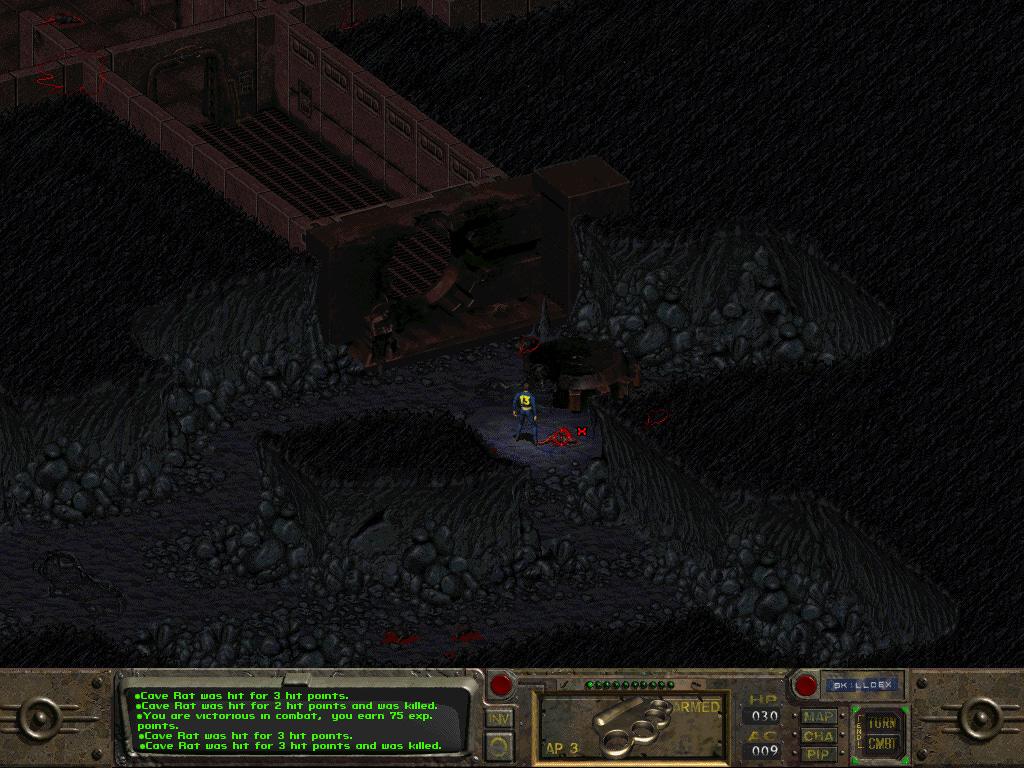
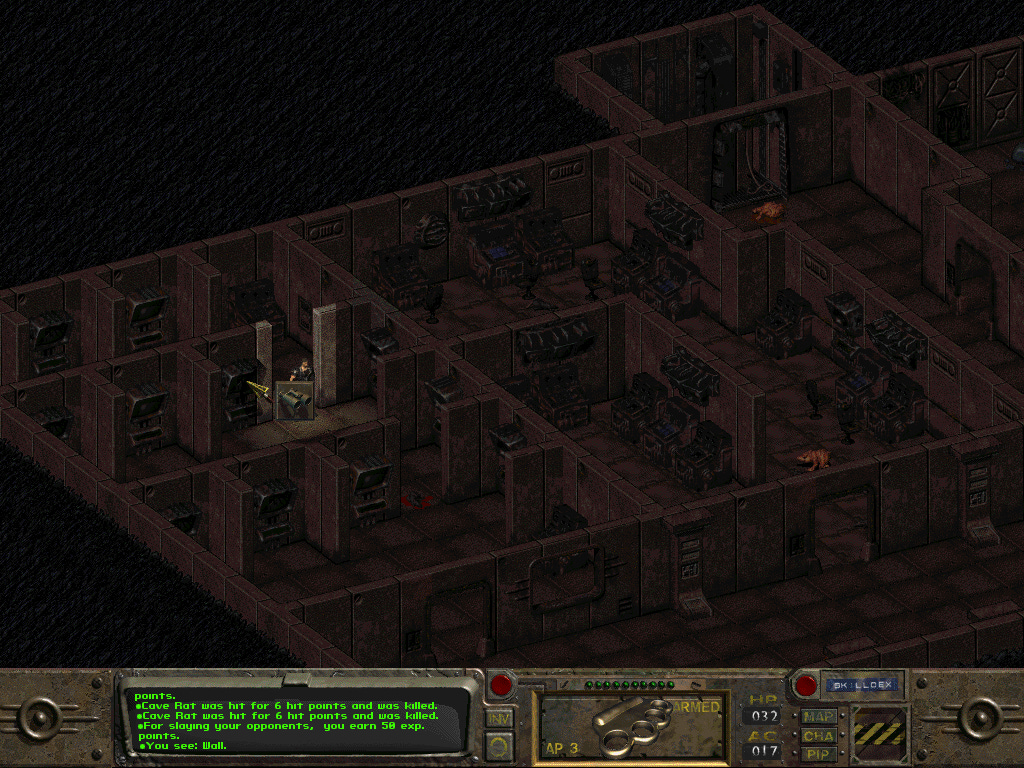
I’ve already touched upon some of my frustrations with the game, so I’ll only briefly repeat these aspects here. The companion AI is bad, the whole companion system is undercooked, and the interface needs work. There’s also the problem that some items are very hard to spot. For example, there’s a locker we can search on the screenshot below, close to our character. Can you spot it?
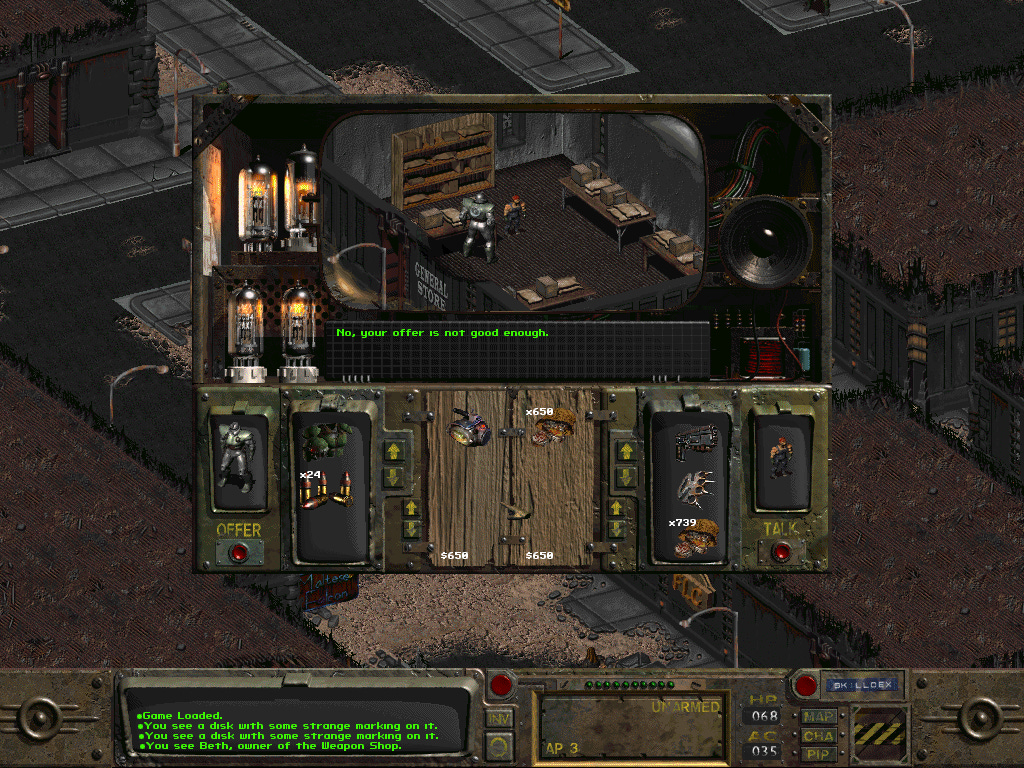
The trading system is also painful to use. The game only allows us to transfer 999 bottle caps at once into the trade offer. However, items regularly cost several thousand caps. That means we have to add the caps in chunks of 999.
Also, vendors don’t have an unlimited supply of caps to trade with. If they run out of caps, we cannot liquidate our loot and need to come back at a later point in time. As we can only carry a limited amount of weight and cannot use our companions as mules, inventory management becomes a chore in the late game. It also doesn’t help that some items just cannot be sold, as they are considered worthless.
Speaking of bugs: Fallout has a lot of them. I encountered the first in my playthrough in the first town of the game. I chatted with a farmer, entered the “barter” screen, and after exiting the conversation was suddenly rewarded with extra experience for helping to improve Shady Sands’ agriculture. Turns out that this is a known bug. The proper way to get the experience is to suggest crop rotation to the farmer. This dialogue option appears if we have a science skill of 40% or greater. Naturally, I was very confused.
I also frequently had issues with weird NPC behavior. For example, a NPC would tell me to return during the day instead of bothering him at night. Fair enough, but he said the very same lines when I returned during the day. Fortunately, leaving and entering the map solved that issue. I also encountered various crashes, and there are some quest bugs that I was fortunate enough to avoid.
Remember the ending slides I just praised in the last section? Yeah, some of these are bugged, and the game will always show a certain one no matter what we do. Sometimes the game also slowed down to a crawl, and I had to reload to fix the performance. Naturally, this is ridiculous for a game with this level of graphical fidelity.
For reference, I played the GOG version without any further fan patches or other mods. I wanted the original experience, and I was curious to see how much work GOG did to make Fallout easily consumable. Turns out, it wasn’t a lot. For my next playthrough I’d definitely use a fan patch like Fallout Fixt to get rid of the bugs. These patches work, but some of them alter the game a lot, which is why I was hesitant to use them.
All in all, the bugs are annoying but nothing backbreaking. The biggest problem is that the combination of the bugs and the cut content makes it difficult to understand whether something doesn’t work because of a bug or because we’re trying to do something that never made it into the game. In these cases, it’s often best to look the quest up in the Fallout wiki, as this mentions any cut content. Some fan mods also restore the cut content, but the results are mixed.
My last frustration was the design of some areas. The game starts up with an incredibly boring tutorial area, and neither Shady Sands nor Vault 15 are very exciting. The game shines in the mid-game, while the last areas we visit can be a drag if we rely on combat. Fallout really needed some more months of development time, and it shows everywhere.
Reception and Legacy
With a Metacritic score of 89/100, Fallout was critically well received. It was praised for its character system, setting, nonlinearity, multiple quest solutions, and combat. Surprisingly, at least one review also praised the story, which, from my point of view, is only serviceable. In terms of sales, the game also did reasonably well, with about 120,000 copies sold in a year. This was enough to green-light a sequel, even though sales expectations were allegedly not met.
Fallout 2 was released in 1998 and was like the original game but simply bigger and more refined. It was well received even though some fans of the original Fallout disliked the goofier writing of the sequel. For example, Fallout 2 features a talking plant that asks us to replant it in a different location because it has grown bored with its current one. Personally, I like these comic relief elements in the bleak setting of Fallout, but I understand that not everyone is a fan.
There were plans to do a proper Fallout 3, but the game was cancelled and the whole studio was shut down. A couple of years later, Bethesda acquired the Fallout intellectual property (IP) and released their own version of Fallout 3 in 2008. This game has almost nothing to do with the original games and has been aptly described as “Oblivion with guns”. Sadly, this has permanently mutated the Fallout IP into a cartoonish caricature of its origins. Hence, it’s very unlikely that a proper Fallout game will ever be made again.
That said, over the years there have been various games that were directly influenced by Fallout: Atom RPG, Underrail, Encased, and Wasteland 2 come to mind. The game’s legacy lives on but chiefly in the indie sector.
Conclusion
After writing so many words, I still feel that I didn’t do the game justice. Despite all its flaws, Fallout’s combination of setting, combat, progression, reactivity, and flexibility is outstanding. While I prefer the sequel, I still highly recommend playing the original. However, it’ll take some “work” to get into Fallout if you’ve never played it before, especially if you expect a Bethesda-style game. My recommendation is that you try it nevertheless if you have any love for RPGs. Just give the game some time. I’d recommend at least finishing Junktown before throwing in the towel.
Thanks for reading. If you enjoyed this post, please consider subscribing to the Substack. Also, please share it with a friend. You can do both with these handy buttons below.