
Sonic the Hedgehog Review
The game that started it all

I’m a big fan of the original Sonic games, so I always planned to write a post on them. Given that Peter Monks has already written great reviews of Sonic 2 and Sonic 3 and Knuckles here on Substack, I figured it makes sense that I review the first game. It also happens to be the very first video game I ever played. So, strap in for a deep dive into Sonic: The Hedgehog.
As the vast majority of my readers are probably deeply familiar with the 2D Sonic games, I’ll only briefly describe the actual game. Instead of spending a lot of time telling you what you already know, I will instead focus more on the history of the game, its game design philosophies, level design, and how it differs from later installments of the series.
That said, I’ll still give you a synopsis just in case you’re unfamiliar with the game.
Game Synopsis
Sonic the Hedgehog is a 2D platformer released for the Sega Mega Drive (a.k.a. Genesis) in 1991. In Sonic, we assume the role of the titular anthropomorphic blue hedgehog and speed through six zones divided into three acts each. Our mission is to stop the evil Dr. Robotnik from turning our animal friends into robots.
To do that, we need to reach the end of each act. In classic platformer fashion, there are a lot of enemies, traps, and other obstacles that want to stop us. Fortunately, we can defeat enemies by either jumping on top of them or curling into a ball and hitting them directly.
At the end of the third act of a level, we get to fight Robotnik in a boss fight. These boss fights vary quite a bit, but with the exception of a single one, the core idea remains the same: we need to deal eight hits to Robotnik before he admits defeat and lets us enter the next zone.
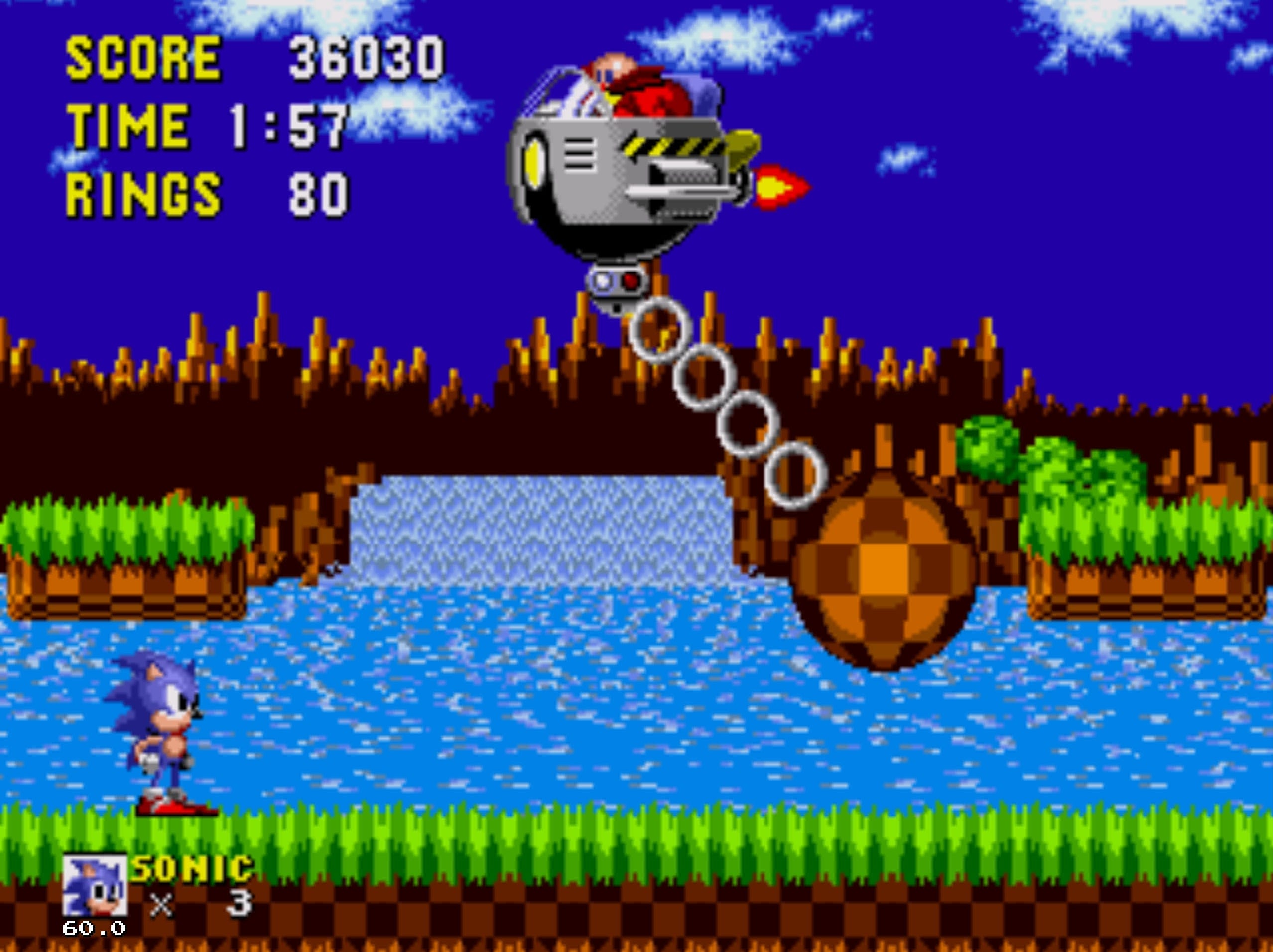
The game differs from other contemporary platformers by its game speed. It allows us to go very fast, but to achieve that, we need to know the zones very well, as it’s incredibly easy to crash into something and lose all our speed in the process.
To address this problem, the game uses a very forgiving health system: as long as we’ve collected even a single gold ring, getting hit won’t kill us. As the levels are chock full of these rings and we can recollect some of them when getting hit, this is very effective at keeping the difficulty down.
If we finish the current act with 50 rings, we can jump into a giant ring to enter a special stage. In this special stage, we’re on the hunt for one of the elusive six chaos emeralds. Collecting all of them unlocks the game’s good ending. However, these levels aren’t easy, as they rotate on their own and require us to compensate for this.


Sonic not only features great high-speed platformer gameplay, it also has a brilliant art style, colorful graphics, and fantastic music.
All of this made the game immensely successful. It sold 2 million copies in 1991 and also became the pack-in game for the Mega Drive, replacing Altered Beast. In total, the game sold over 15 million copies, making it by far the most sold Mega Drive game of all time. While these numbers are surely bolstered by the game’s pack-in status, they are still very impressive.
This success wasn’t an accident, as Sonic was a very deliberate product. To understand this, we need to look into the game’s development history.
How Mario Made Sonic
Sonic’s story begins back in 1989. Sega felt the need to finally come up with something to properly compete with Nintendo in the home video game market. At the time, they had the more powerful console, as the Mega Drive was already launched while Nintendo’s SNES (a.k.a. Super Famicom) was still in development. However, Nintendo nevertheless held a crushing market share of ninety percent in Japan, which was unacceptable.
A big reason for Nintendo’s incredible success were the Super Mario Bros. games. As a result, the leadership at Sega decided that they also needed a strong mascot and games of similar quality. To achieve this, an internal competition was held, starting in November 1989.
At that time two young employees were looking for their next assignment: developer Yuji Naka and designer Naoto Oshima. Naka wanted to build an action game to challenge Mario, while Oshima wanted to build a game with a fast character. The two teamed up in early 1990 and started on the game that would become Sonic.
In terms of design ideas, Naka was heavily inspired by Ghouls ‘n Ghosts as well as the original Super Mario Bros. However, he wanted to produce a faster game, which nicely dovetailed with Oshima’s vision. Naka also had the idea that increasing game skill should allow the players to complete levels faster and faster. Furthermore, he insisted on a super simple control scheme with only one action button.
Initially Naka and Oshima picked a rabbit as the game’s mascot to reflect its fast pace. The rabbit was supposed to attack by picking up things and throwing them at enemies. However, this didn’t fit the desired fast pace and clashed with the simple control scheme. To help with this problem and to further develop the game’s mascot, Hirokazu Yasuhara joined the team.
Yasuhara suggested merging the attack with the jump to keep the controls simple. After some brainstorming on how to make this work, Naka suggested a somersault attack that could also be used on the ground when the character was rolling. While this was a neat solution for their problem, it also meant that using a rabbit didn’t make sense anymore.
The idea of a rolling attack led the team towards animals that were spiky and tended to curl up. In the end, they settled for the blue hedgehog that we know and love. A lot of work was put into Sonic’s design to make him both cool and cute. It was very important that he appealed to western audiences as well, as Sega wanted to capture the American market. In the end, all this work paid off as Sonic won the contest as the best of 200 submitted designs.
Full production of Sonic started in April 1990, with the team expanding to six people in total. Originally, the game was planned to release on 21 November 1990, the same day that Nintendo planned to release the SNES and Super Mario World in Japan. However, this didn’t work out, as the game wasn’t ready yet to match the quality of Super Mario World. It got pushed back and finally released in June 1991 in the United States and Europe. The Japanese version arrived one month later.
Design
As we’ve already learned from the previous section, two of Sonic’s core design ideas are super simple controls and speed as a reward for playing skillfully. The game’s speed is supposed to show off the Mega Drive’s capabilities, but it doesn’t get handed to the player on a silver platter. High speed can only be achieved if the player knows the level well enough to dodge the many enemies and traps inside it. Without this skill, going fast only means crashing into something and losing our rings.
As a side note, the iconic ring system was only added to the game after playtesting began. Naka’s original idea was that the players would play slowly at first and only attempt speeding up once they knew the level. However, this was not the case. The players wanted to go fast from the very start and hence died very quickly with a more traditional health system. So, Sonic Team added the ring system to make the game more forgiving.
That said, even with the ring system, it’s not easy to go very fast in Sonic 1. Contrast that to a modern Sonic game, especially a 3D one, where speed is instantly available via the boost. In that regard, Sonic has strayed very far from his roots.
To make Sonic’s high top-speed controllable, Sonic Team decided to use a momentum-based system, similar to the Mario games. Sonic needs some time to accelerate before reaching a meaningful speed. This allows players to keep control over how quickly they want to go, which is also necessary to tackle areas that require precise movement. If Sonic were to instantly reach his top speed – similar to Mega Man, for example – the game would be very difficult to play.
While Sonic also takes some time to decelerate, he can nevertheless stop or change directions very quickly. This allows the player to better react to mistakes. Without this feature, Sonic would probably feel like he was slipping on ice all the time.
In addition to being momentum-based, the movement is also clearly inspired by pinball. There are a lot of springs and other elements in the levels that Sonic can bounce off from and use to generate speed. The most extreme example of this is Spring Yard zone that partially feels like an actual pinball game.
While these level elements help, there’s still a glaring hole in Sonic 1’s move set, as there is no way for the player to quickly accelerate after losing speed. This omission is fixed in the later titles of the series by the addition of the spin dash. It was also added to the mobile port of the game.
In total, the game’s movement is designed to give the player as much control as possible while keeping the controls as simple as possible. It accomplishes this mission with flying colors. There’s no other comparable game that comes to my mind with such a simple but satisfying move set.
In spite of its high speed, Sonic is a game that’s incredibly easy to learn. The game does a great job at teaching you its core concepts in the first few minutes of gaming. Despite this very gentle learning curve, the game is still deep enough for experienced players to show off their skill, chiefly by completing the levels very quickly.
Even though the game features both a timer as well as a score, both of these are of little relevance. There is no high score tracking in the game, and the extra lives we can earn by collecting 50,000 points are irrelevant in the grand scheme of things. I’m unsure why both these elements are in the game. They seem like a relic of the arcade area to me.
To sum up, Sonic’s key design ideas are very simple momentum-based controls, a forgiving health system, speed as a reward, as well as being easy to learn but hard to master. Next, we need to talk about the game’s level design.
Zones
Sonic’s level design differs from other contemporary platformers. It’s much more vertical, more curved, and offers multiple paths through a level. To make this more clear, let’s compare one zone of Super Mario World with one of Sonic 1. The differences are stark.

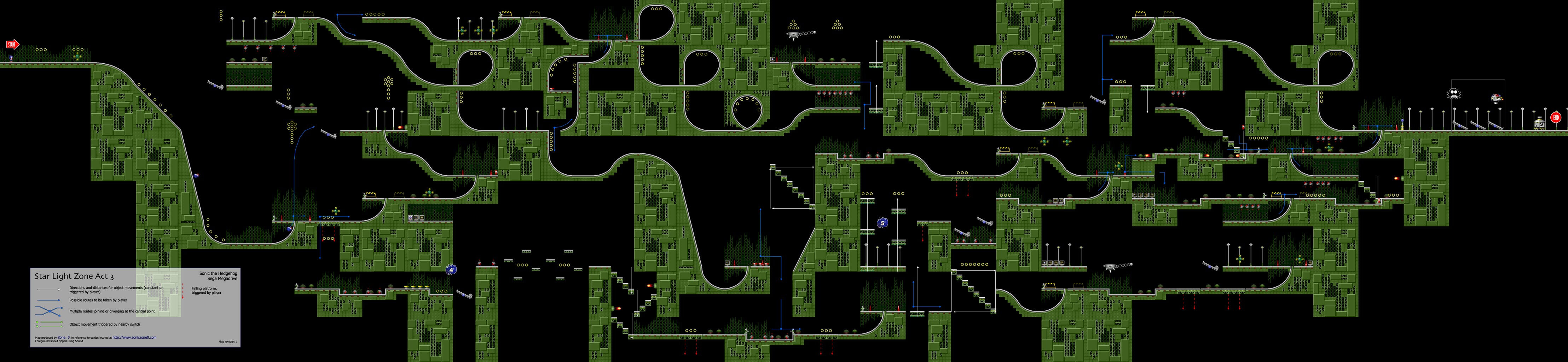
There are also many hidden secrets in the levels. In addition to useful items, these secrets also serve as shortcuts that allow us to finish the level more quickly and to bypass certain challenging parts. The following YouTube video gives a great overview over them.
Even though the game features only six zones in total, there’s a lot of variety in the game as each zone plays differently. In general, we can divide the zones into flow-oriented zones (Green Hill, Spring Yard, and Starlight) and precision-oriented zones (Marble, Labyrinth, and Scrap Brain). Flow-oriented zones actually allow us to go fast and serve to show Sonic’s unique style of play. In contrast, the precision-oriented zones are so filled with obstacles that going fast is almost impossible. They more closely resemble more traditional, slower platformers.
This duality of level design exists because of differing visions in the development team. Apparently, Naka and Ohshima wanted a flow-oriented design while Yasuhara preferred a more classic one. This disagreement was never properly resolved. It happened that Naka or Ohshima removed a trap because they felt that it disrupted the flow only for Yasuhara to add it back in. Surprisingly, this didn’t lead to bad blood. Ohshima is on record that he felt that the process led to a balanced game.
Interestingly, we can extrapolate how Sonic would’ve looked like if one side had won by looking at Sonic 2 and Sonic CD. Sonic 2 was spearheaded by Naka while Sonic CD was directed by Yasuhara. Both games turned out very differently. In the long run, the flow-based approach became the dominant one, probably because it allows Sonic to shine more.
Personally, I rather like the duality of Sonic 1. I don’t think that the precision-oriented zones are strictly worse than the flow-based ones. In fact, Marble Zone is one of my favorites in the game. I think it’s kind of sad that precision-oriented zones more or less completely vanished from the franchise. The only comparable zones to Marble Zone in later Sonic titles that I can think of are Mystic Cave from Sonic 2 and Sandopolis from Sonic & Knuckles (endgame zones in Sonic games always tend to be precision-oriented, so I don’t count them in this context). While I have to agree that a flow-oriented approach is the better fit for Sonic, I think that more variety would’ve made these fantastic games even greater.
Last, I need to briefly talk about the special stages. They aren’t great, and the payoff for collecting the emeralds is pathetically small. However, I much prefer them to Sonic 2’s approach, as they are more forgiving. Sonic 2’s approach requires a very skilled second player to control Tails, while Sonic 1’s can be easily done on our own. I still think that Sonic 3’s blue spheres approach is the best one, though.
Conclusion
Sonic 1 was the start of something special. In retrospect, the first game tends to get overshadowed by its successors chiefly because of its level design. I think that’s a bit unfair given how innovative Sonic was at the time. Also, Green Hill Zone is without a doubt the most iconic Sonic level of all time and probably one of the best starting zones of all time as well.
Personally, I actually prefer Sonic 1 over Sonic 2 chiefly because of the special stages and a couple of very annoying zones (Metropolis, Sky Chase, and Wing Fortress). Sonic 2 is without a doubt the more polished game, but the heart wants what it wants. That said, I’d still pick Sonic 3 over Sonic 1 every day of the week.
If you haven’t played Sonic 1 for whatever reason, you definitely should. Sonic Origins is the latest re-release of the game, and even though I hate it for many reasons, it does the job. The original game also has a very good mobile port that works surprisingly well. Personally, I always emulate the game or play it on my Analogue Mega SG.
In case you’re still hungry for more information on Sonic, I can highly recommend Sega Retro’s articles on the game and its development history. Also, there’s a great YouTube video that covers the game’s design in excruciating detail.
Thanks for reading. Please consider subscribing to the Substack. Also, please share it with a friend. You can do both with these handy buttons below.
You've done a fine job here Felix. I had never planned to write about Sonic 1 myself, since I don't have as much affection for it - Sonic 2 was the first I played, and going backwards would have felt difficult. But we can't deny that Sonic 1 laid the foundations for the future of the series.
I was interested in hearing about the flow and precision based levels, which now makes a lot of sense. With Sonic 1, I could clearly see the difference in the alternate zones, and why I personally felt that Sonic 2 felt much smoother in terms of flow - literally, it seems. And how Sonic CD, designed by the other half of the team, felt different again despite being released around a similar time to Sonic 2. Interesting stuff.
This brought back some memories! I also loved the secret areas in Sonic 1, and am always surprised that I can remember exactly where they are, even after several years of not playing it 😅