
System Shock 2 Review
A brilliant commercial disappointment

Some games aren’t as successful as they deserve. Today, I want to discuss one of the most extreme examples of this: System Shock 2. System Shock 2 is an action adventure / role-playing game (RPG) hybrid with survival horror elements. It was developed by Looking Glass in cooperation with Irrational Games and released in August of 1999.
Even though the game received glowing reviews, it only sold about 58,000 units eight months after release. As a result, Looking Glass was closed in April of 2000. Even though System Shock 2 had a short development time of 18 months and a modest budget of 1.7 million US dollars, its underperformance was the final nail in the coffin.
That’s a shame, as System Shock 2 is a fantastic game and one of my all-time favorites. I was blown away when I played it on release, and my appreciation of the game has only increased over the years. So, it’s time for a dedicated review of this masterpiece here on Corerunner.
Before we get too deep into the weeds, we need to talk about the fact that this game is a sequel. The original System Shock was released in 1994 and is a very different game, as it has no RPG elements. While System Shock 2’s story builds on some story elements from the first game, it’s perfectly possible to enjoy part two without playing the original. That’s how I did it back in 1999 as well.
If you want to experience the original System Shock, you might want to take a look at the 2023 remake of the game. While I hated that game, it’s certainly much more accessible than the original. In any case, I recommend playing System Shock 2 instead, as it’s a much better game.
With all of that out of the way, let’s dive into the game, starting with the setting.
Setting
System Shock 2 takes place in the year 2114, 42 years after System Shock 1. We assume the role of an unnamed soldier on board the starship Von Braun. The Von Braun is the first faster-than-light starship and is currently on its maiden voyage.
Five months into the journey, we awaken out of cryosleep. It’s clear from the very beginning that something is horribly wrong on the ship. To start with, we barely avoid getting sucked out into space. Then, we discover that we have lost some of our memories and were implanted with experimental military tech that allows us to improve our abilities with cyber modules.
To make things worse, the ship is overrun with humanoid mutants that attack us on sight. Most of the ship’s crew is dead, and the main power is out. Fortunately, we are in contact via email with Dr. Janice Polito. She has a plan: we need to restore power and meet her on deck four. Of course, that isn’t exactly easy, so it will take a couple of hours until we actually meet her.
The game has a very bleak and unsettling atmosphere. We’re isolated, with Polito as our only contact. We find a lot of audio logs during gameplay, which give us an insight into the rest of the crew. These logs also tell a big part of the story and frequently contain key information. However, the vast majority of humans that we meet during the game are either dead or dying.


To make things even creepier, we quickly realize that the hostile mutants are former crew members. Some members of the crew realized this as well and chose suicide over mutation. The game doesn’t shy away from explicitly depicting this. Sometimes we even get a live view as our implants occasionally let us see the last moments of some poor soul.
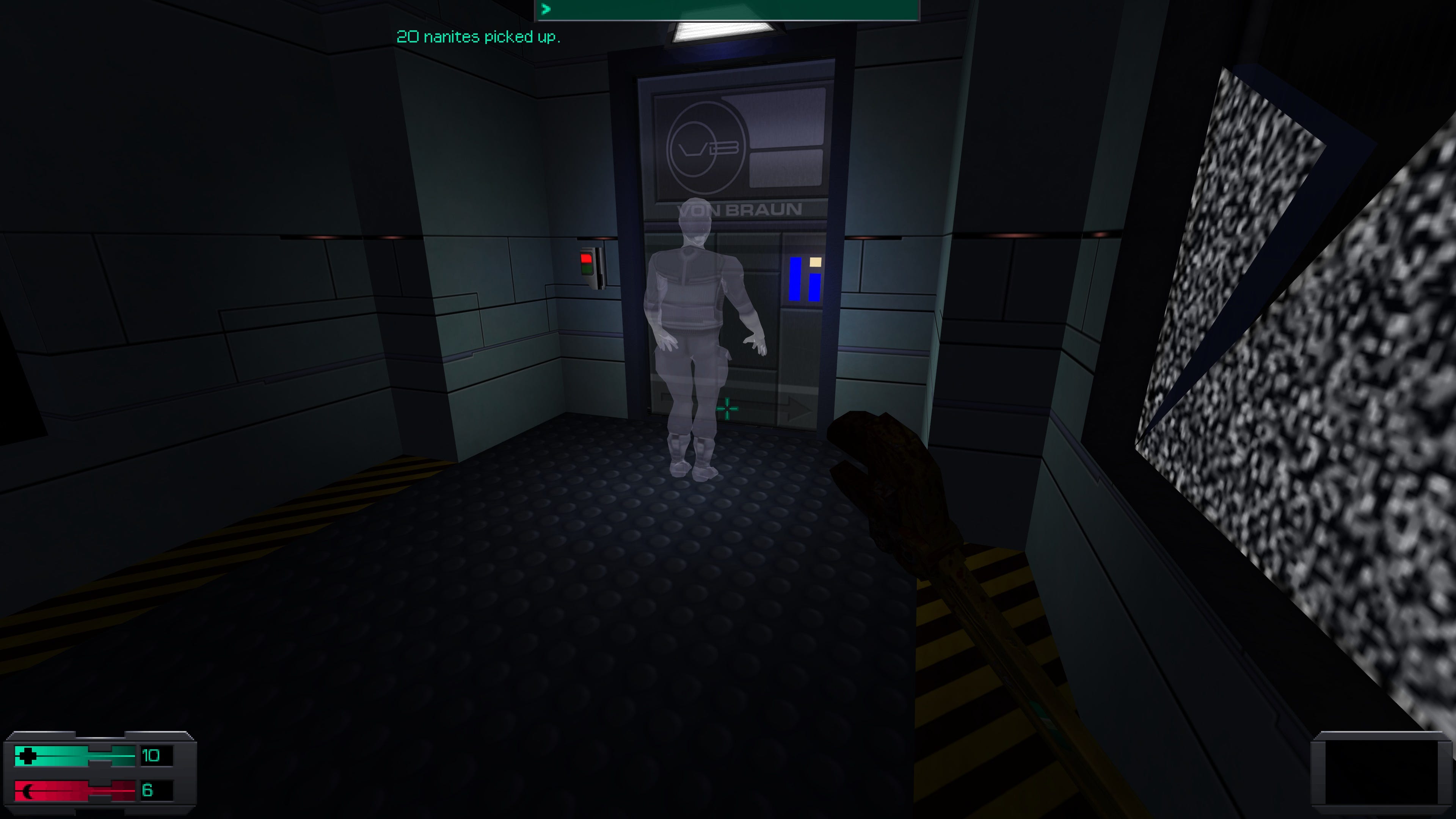
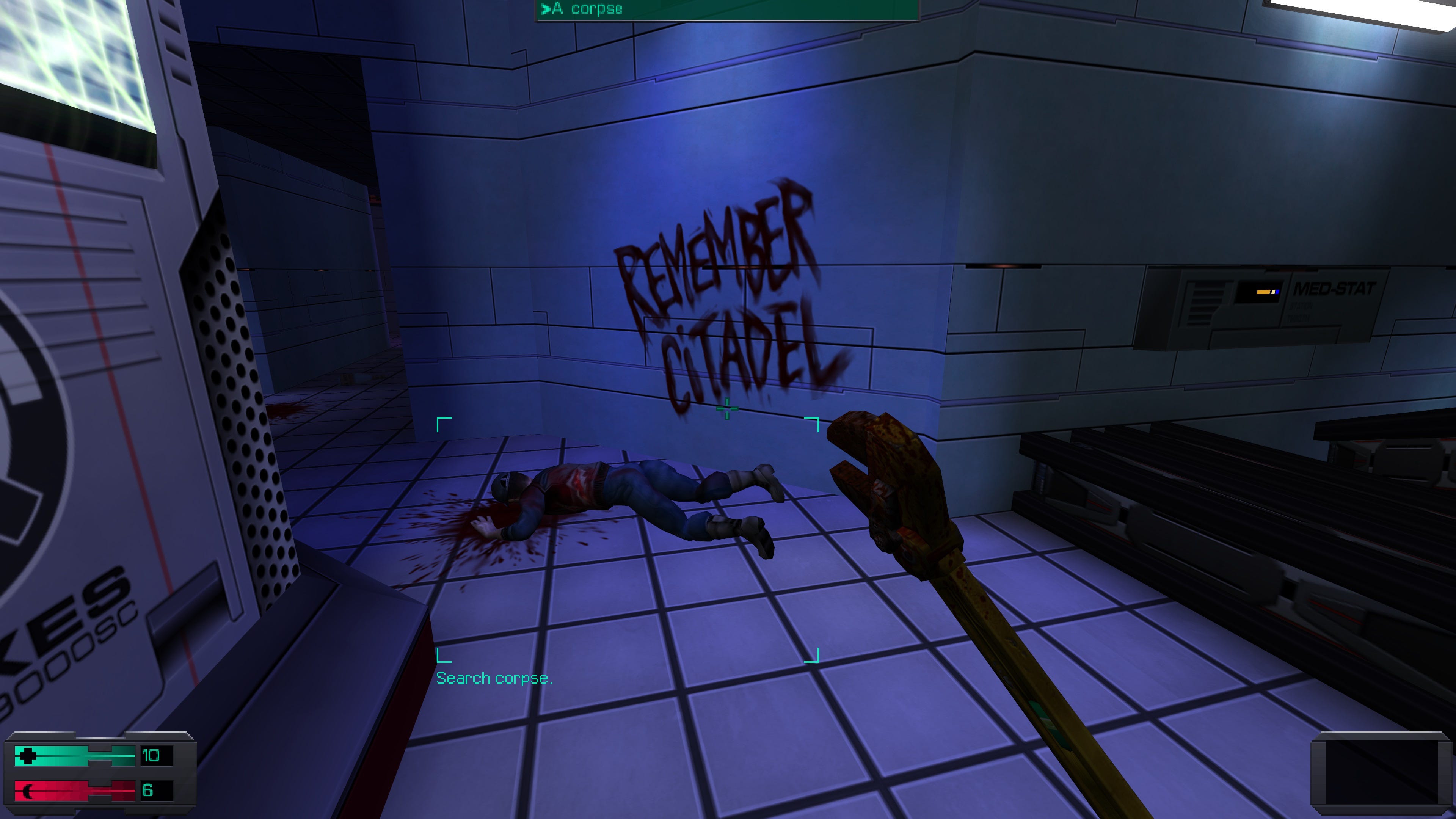
As we can see, the game leans heavily into survival horror. This also affects the game mechanics as resources are scarce and the enemies respawn indefinitely. There is no place on the ship where we are truly safe.
However, System Shock 2 isn’t a hardcore horror game. There are no jump scares in it, and while we do feel vulnerable, I don’t think that the game is very scary. This is a good thing, as I don’t like horror. That said, the game is very good at making the enemies threatening, and hence there’s always a certain amount of tension.
But how exactly does the game play? Let’s discuss this next.
Gameplay
At first glance, System Shock 2 looks like a shooter. While combat is a big part of the game, it’s an action-adventure rather than a pure shooter. In addition to fighting enemies, we explore the ship, collect all kinds of useful items, solve puzzles, listen to audio logs, manage our equipment, and work on improving our character.
We do all of this to reach our current objective. There are no side quests in the game. Instead, we always have a primary goal that involves multiple subgoals. Let’s take the situation at the start of the game to illustrate this.
After barely having avoided getting sucked into space, we find ourselves on deck two of the Von Braun. Our main goal is to meet Polito on deck four. However, the main power is out, and, hence, the elevator doesn’t work. We need to reenable power on deck one before we can reach Polito.
However, deck one is only accessible via a maintenance shaft that is secured via a code. We cannot hack the keypad, so we need to figure out the code somehow. We know that another crew member called Watts has the code, but he’s in a different section of deck two.
To reach him, we need to go to the medical sector. Access to it is blocked by a couple of doors without power. We need to take the nearby battery, recharge it at a recharging station, and reinstall it. Once this is done, we can enter the medical sector.
Naturally, our problems continue there. We need to find two different access cards to reach Watts. So, we search every nook, container, and dead body in the area (in general, we search a lot of containers in the game). After that is done, we can finally reach Watts and get the code from him. This brings us one step closer to reaching Polito, as we can now go to deck one and restore the power, but, naturally, that won’t be easy either.
While we’re doing all of this, we have to fend off the enemies roaming around the ship. As mentioned, these respawn indefinitely, so we always need to be on our guard. To fend them off, we can rely on melee attacks, ranged attacks, as well as psi powers. However, at the start of the game, we will mostly use our trusty wrench in melee combat, as ammunition is rare.
The game’s ranged combat is fine. While there aren’t a great number of weapons in the game, the gunplay is satisfying. Some weapons have multiple fire modes as well as different ammo types. Picking the correct one for each enemy is crucial, as we mustn’t waste ammo, and we’re not very tanky. Here’s a video of me fighting a midwife monster with the pistol in burst mode using armor-piercing ammunition.
Melee combat, however, is quite janky. It’s acceptable when we’re fighting ranged enemies in melee combat, but if both we and our enemy are using melee attacks, then things get very janky.
Sadly, this is a common scenario, especially in the early game, as the basic mutant enemies attack with lead pipes. So, we need to dodge their attacks while trying to land hits of our own. You can see in the videos below how that looks. First, I fight a ranged mutant, then a melee one.
As we can see, the game certainly doesn’t have the best melee combat system. However, one does get used to it and gets better with practice.
System Shock 2 isn’t primarily about combat. It’s about exploring the ship, experiencing the story, getting more powerful, and reaching our goals. The enemies are just obstacles in our way.
We don’t gain anything from fighting them, especially as many of them carry little to no loot. Ideally, we would want to avoid them completely. However, this isn’t an option, as the game has no stealth system with the exception of a certain high-level psi power.
There is only one way to reach a goal in System Shock 2. The game isn’t like Deus Ex where everything can be solved in at least two different ways. While this does make the game much more linear, it also creates a more believable world, as not every room is riddled with air ducts to enable stealth.
Besides the enemies, navigation is another challenge. The ship is big, and we’re expected to backtrack quite a bit. Especially later in the game, we need to jump between different decks. Fortunately, we have a useful map as well as a mini-map. The game also automatically keeps notes so that we don’t need to replay an audio log if we forgot some crucial information.
Naturally, the game has no quest markers. Instead, we’re expected to pay attention to the ship’s layout and the hints we receive to find where we need to go. We can also manually place map markers to keep track of things that aren’t marked on the map by default.
In addition to the enemies, we also need to worry about the ship’s security system. There are a lot of cameras placed on the ship. If they spot us, their light turns yellow.
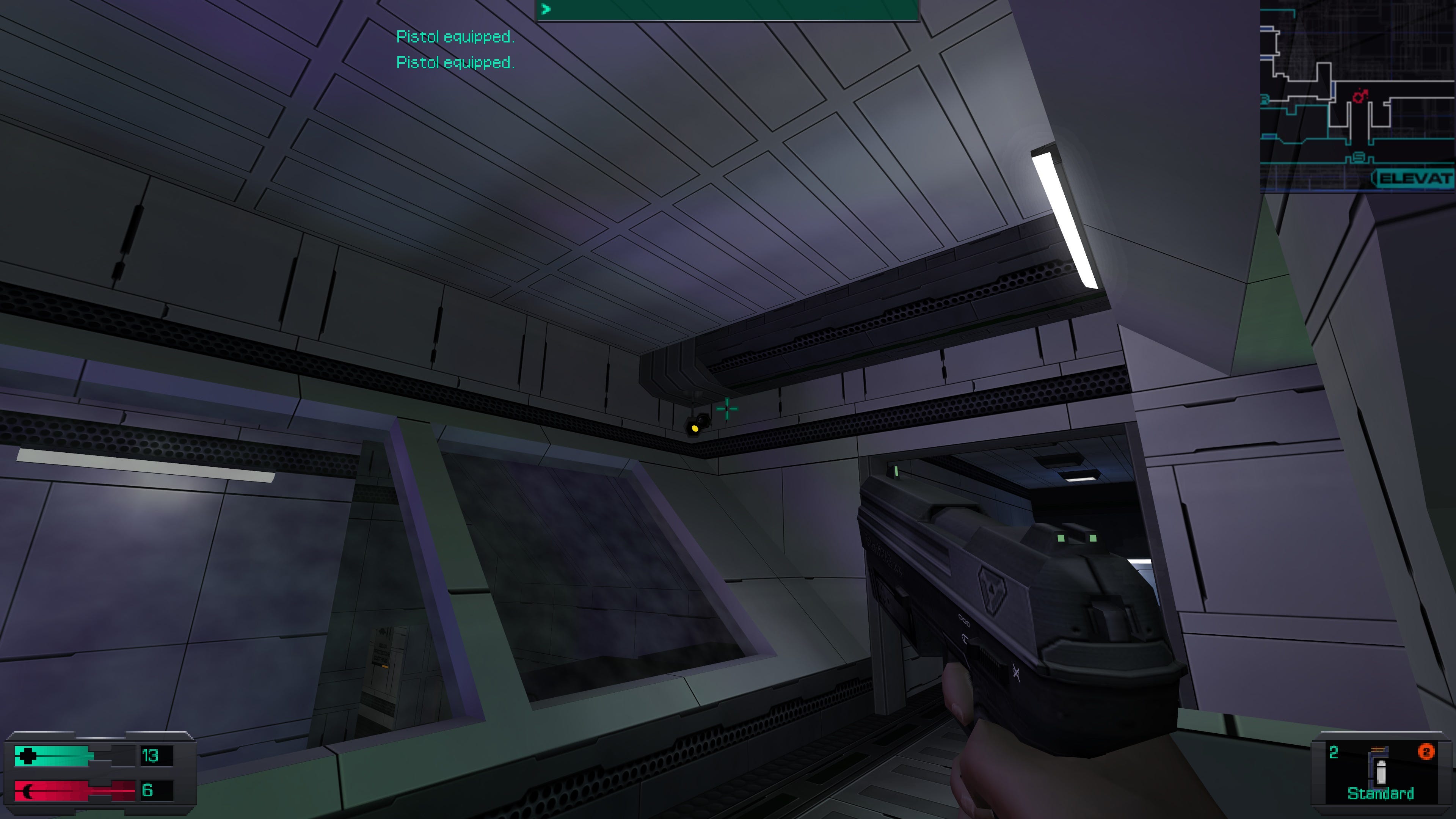
We then have a couple of seconds to destroy the camera before it raises the alarm. If we fail, the game will spawn a lot of enemies near us and continue doing so until we disable the alarm at a security station or until a timer runs out.
To avoid this, it’s a good idea to hack the security system. This temporarily disables all cameras as well as all automatic turrets. Naturally, we should still destroy the cameras and the turrets while they are helpless.
If we combine all of these factors and add in the other hazards of the ship (radiation, toxins, lethal falls), then we end up with a deadly combination. We will die a lot in System Shock 2, especially on the higher difficulty levels.
Fortunately, we can save the game at any time. To further help us, the game features reconstruction chambers. Each deck has one of them. If we managed to find it and turn it on, dying on this deck no longer results in a game over.
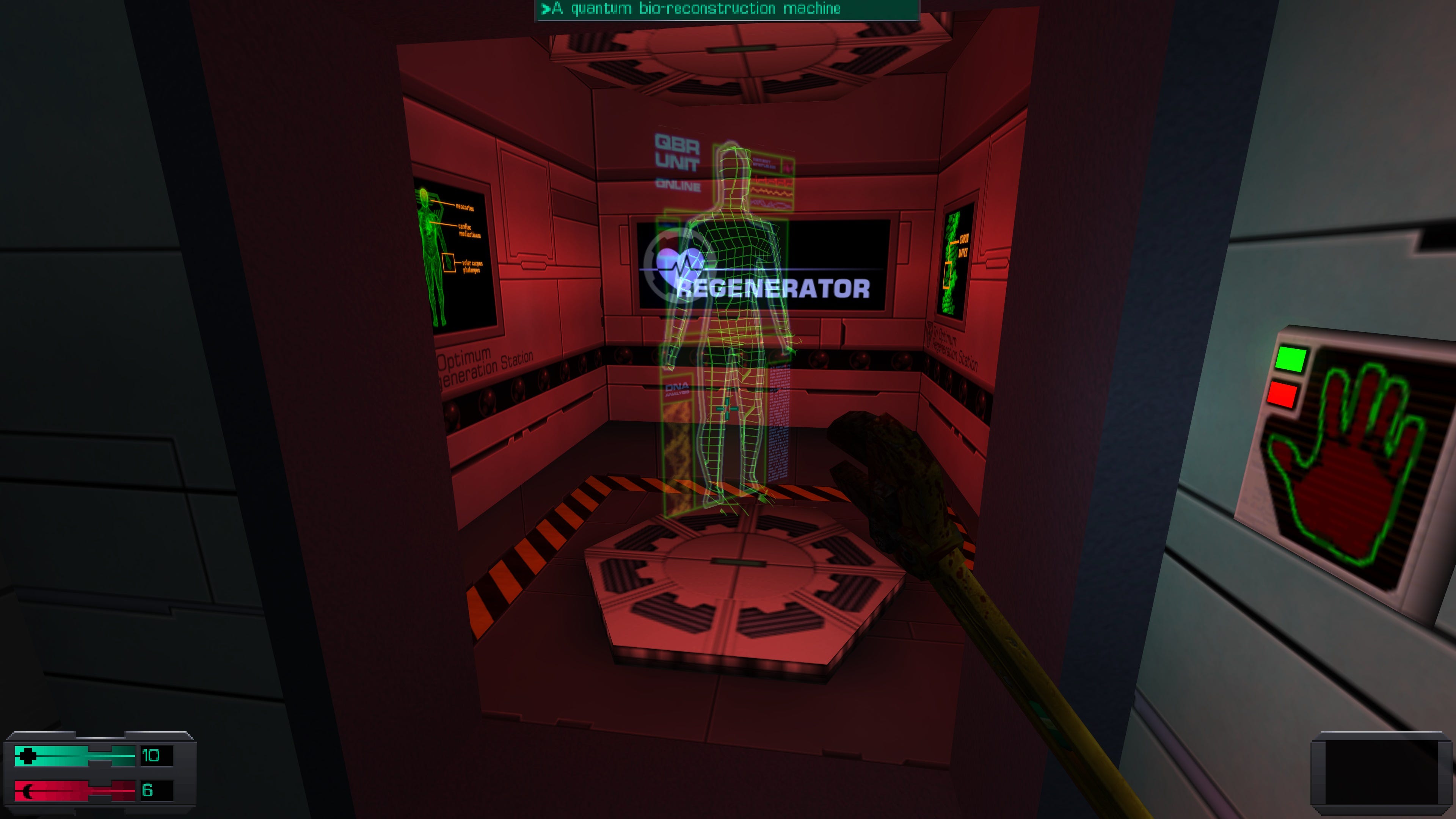
Instead, we respawn in the reconstruction chamber with a small amount of health. We even get to keep any items we picked up before we died. This is super useful, even though we lose a bit of money during each reconstruction.
But be warned: it’s possible to run out of money if we overly rely on the reconstruction feature. This will bite us further down the road, as we will lack crucial resources in the endgame. When in doubt, load a save game rather than relying on reconstruction.
Another interesting aspect of the game is that the world is persistent. So, all items remain in their place. That also applies for any item that we drop to make room in our inventory. That’s very handy as inventory space is quite limited.
To briefly sum up: the core gameplay of System Shock 2 is a combination of exploration, combat, and problem-solving. On each deck we get confronted with a new task to reach our goal of regaining control of the ship.
But what about the RPG elements I mentioned at the start of the post? Let’s discuss these next.
RPG Elements
System Shock 2’s RPG elements are rather unusual. There are no levels, no experience points, and no classes. Instead of an elaborate character creation at the start of the game, we get to pick one branch of the military: either marines, navy, or the psi-focused OSA.
Each of the branches offers us different starting bonuses. We pick these by choosing certain assignments. In practice, this means choosing between three possible assignments three times in a row.
This is all presented in a very minimal fashion. Making a choice means picking a certain corridor over the two alternatives. It’s rather similar to how difficulty selection was done in games like Quake. The assignments themselves are described with a few lines of text.


After we’ve reached the actual start of the game on the Von Braun, we’re free to further develop our character in any way we see fit. Our branch choice doesn’t matter here. However, it makes sense to pick the optimal combination for the build that we have in mind.
Our character has five statistics (strength, endurance, psionics, agility, and cybernetic affinity). Most of these are self-explanatory with the exception of cybernetic affinity. Basically, this makes hacking things easier.
In addition to the statistics, we can also learn a bunch of skills. These are grouped into technical skills, weapon skills, and psi skills. Technical skills include things like hacking and weapon maintenance. Psi skills include individual powers as well as unlocking higher skill tiers. Combat skills increase our proficiency with a certain weapon type.
Both statistics and skills are acquired and increased at dedicated upgrade units. However, we need to part with our hard-earned cyber modules in exchange. We can find these at various places in the ship and often receive them as a reward for completing our current task.
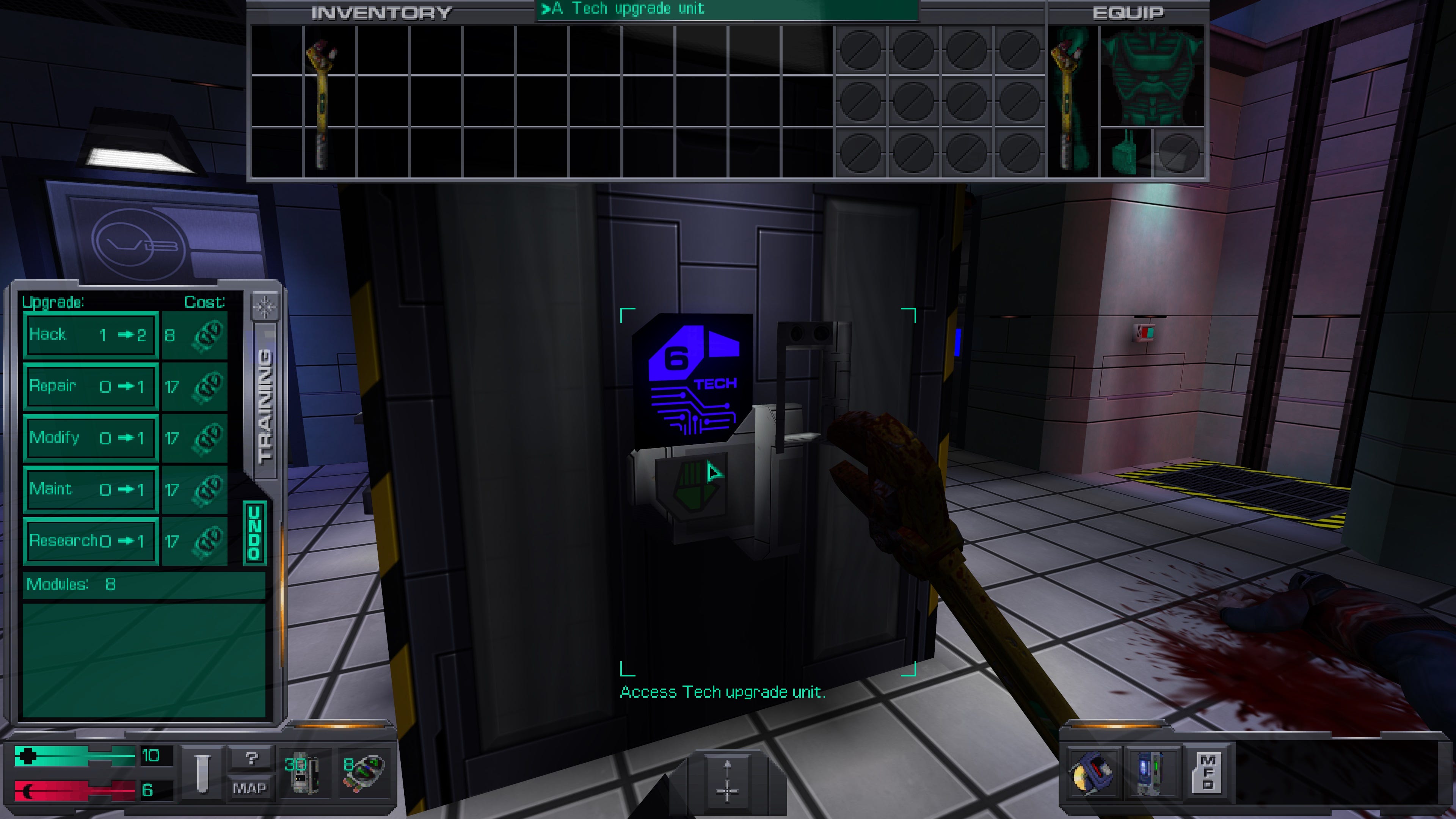
As the total number of cyber modules in the game is limited and is insufficient to learn everything, we need to think carefully about our investments, especially as we can’t undo them.
However, the game can be completed with various different builds. There are only two mandatory skills, and the game provides us with the required modules to learn them to avoid any dead ends. So, we have total freedom to build our character in a way we see fit.
Do we want to be a skilled hacker who primarily uses energy weapons? Or do we prefer a military grunt who just shoots everything with the assault rifle and the grenade launcher? What about a skilled psionic user who destroys enemies with the power of his mind and can even turn invisible? The choice is ours.
The game also supports all kinds of hybrid builds. For example, a very strong build combines a melee-focused character with some psionic skills that boost our melee damage. This allows us to kill almost everything in melee with one or two hits. However, we also need to invest in the research skill to get the best melee weapon in the game, and we need to at least tolerate the game’s janky melee combat.
System Shock 2 deserves praise for how well it combines RPG elements with shooting. In general, this is difficult to do. Games like Deus Ex and Fallout 3 failed to do this well, as their RPG elements directly influence accuracy. This leads to a disconnect where the player knows that the shot should’ve hit, but the game disagrees, as the chance to hit is too low.
System Shock 2 avoids this, as guns are always accurate. Increasing weapon skills increases the damage of the corresponding weapon type and grants access to more powerful weapons. This is a clean and understandable solution that allows for predictable and coherent gunplay.
Next, we need to talk about character progression. I have said many times that a good character progression is essential for RPGs. System Shock 2’s progression is very good, as every upgrade feels meaningful. In that regard, the game profits from its rather coarse-grained system. It has a low number of skills and only six levels per skill, which makes it easier for every increase to have an impact.
System Shock 2 doesn’t quite reach the brilliance of something like Gothic or Drova in that regard, as it lacks the moments of triumph that these games provide when we finally one-shot enemies that used to do the same to us.
An interesting side effect of the game’s RPG system is that it makes grinding impossible even though the game features respawning enemies. As enemies can’t drop cyber modules, they are only a liability rather than an opportunity to get stronger.
To sum up: System Shock 2 cleverly combines RPG elements with action-adventure gameplay. I think that the game was never surpassed in that regard. Interestingly, the game’s difficulty settings also directly influence its RPG system.
Difficulty
System Shock 2 is a difficult game by modern standards. Wasting resources can bite us in the long run, as the last stretch of the game is filled with many enemies and light on resources. As a result, we might be unable to finish the game because we were too wasteful hours ago.
Hence, I strongly recommend sticking to “normal” difficulty when playing the game for the first time. Increasing the difficulty reduces our hit points as well as our psi points. It also raises item prices and, most importantly, greatly increases cyber module costs for character upgrades.
Furthermore, enemies drop less loot on higher difficulties, and our weapons degrade faster, requiring us to put more resources into maintaining them.
All of this combined strongly reduces the margin of error. It also limits us in terms of experimenting with different builds. Higher difficulties are only for players familiar with the game, as they know how to maximize efficiency.
While the game tries to reduce friction via the reconstruction chambers and the freedom to save the game at any time, it might be too hard for some players. Fortunately, we change the difficulty level at any time.
Presentation
System Shock 2 was never a particularly pretty game. Even when it came out, its graphics were nothing to write home about. Today, the vanilla version of the game is hard to look at. Hence, I play the game with a couple of texture mods to make it easier on the eyes.


On the flipside, the game has an absolutely fantastic sound design. The music is subtle but very effective at creating a foreboding atmosphere. Each enemy type makes distinct noises that allow us to notice them way before we can see them. Just hearing certain enemies nearby can be enough to send a chill down your spine.
The game also has great voice actors. These make the audio logs scattered throughout the game so interesting. As these mainly drive the games’ story, this makes a big difference.
In terms of world design, Looking Glass invested a lot of effort to build a believable world. As a result, the Von Braun has everything one might expect from a spaceship, including lots of toilets. There’s even a recreation deck where the crew can decompress. The world-building makes the game feel much more organic compared to more arcade-inspired games.
Legacy
Even though System Shock 2 was a commercial flop, there have been persistent rumors of a third installment of the series over the last ten years. So far, nothing has materialized, and personally, I don’t think that we will ever see it.
However, the game did receive a remaster in 2025, which included ports for all current consoles. As the original game is now delisted on GOG, the remaster is the best option to play the game today. Sadly, it’s quite expensive when not on sale.
System Shock 2 has a couple of spiritual successors. The most prominent one is the BioShock series, which was created by Ken Levine. Levine was the lead designer of System Shock 2, so the similarities between the games aren’t surprising.
Another spiritual successor is Arcane Studio’s Prey from 2017. It’s a much more non-linear experience than System Shock 2 with more player choice and a quite interesting story. While it doesn’t reach the brilliance of the original, it’s still a good game.
Sadly, similar to System Shock 2, Prey underperformed commercially. I think that this type of game only has a rather small market. Hence, I don’t expect it to ever become mainstream.
Conclusion
System Shock 2 is a fantastic game that I strongly recommend to anybody interested in action-adventures and/or RPGs. In its genre, the game is unsurpassed to this day and one of the finest products of the golden age of PC gaming.
Thanks for reading. Please consider subscribing to the Substack. Also, please share it with a friend. You can do both with these handy buttons below.
Great writeup! 58K copies is criminal. I had no idea.
I spent hours as a kid in the demo for SS2, just barricading myself in a room and playing the Ultima clone on the Gamepig before going to school. Something about the game-within-a-game that didn't pause the original game was really cool to me. I still love that you can hack it to unlock even more minigames.