
Warcraft III Review
My favorite Blizzard game

While real-time strategy (RTS) games are a niche genre today, they were highly popular in the 90s and early 2000s. Blizzard Entertainment was one of the kings of the genre with their highly popular Warcraft and StarCraft series. Today, I want to talk about my favorite Blizzard RTS game: Warcraft III.
Warcraft III is quite remarkable, as it is actually an RPG/RTS hybrid. Interestingly, Blizzard never used any RPG elements in their RTS games before or after Warcraft III. To understand why the game contains RPG elements, we need to look at its development history.
Development History
Warcraft III’s development was difficult. Originally, the game that became Warcraft III shouldn’t even be the third entry in the series. Instead, it was supposed to be a spin-off called “Warcraft Legends”.
Work on Warcraft Legends began in 1998. At the time, StarCraft: Brood War was in development, and Warcraft Adventure: Lord of the Clans had just been cancelled. With Lord of the Clans gone, Blizzard looked for a different way to continue the Warcraft series. However, rather than just doing another RTS, Blizzard wanted to do something fresh.
In fact, StarCraft served as the blueprint for what not to build. Art director Samwise Didier recalls that the team wanted to avoid the “mass army vibe” of StarCraft and instead wanted to focus on individual units instead.
They went so far down this road that they ended up with a game without any resource gathering and base building. It also had a minimal interface as well as an over-the-shoulder camera.
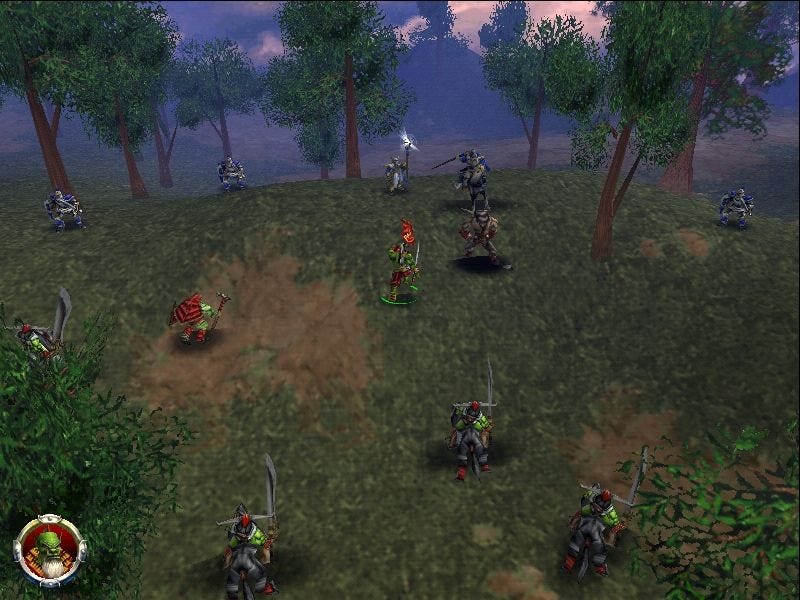
How exactly it played is hard to reconstruct. Interestingly, it was described as very similar to the 2005 MMO GuildWars. That’s not a coincidence.
The Warcraft Legends project was led by Mike O’Brien, who had come up with the initial design and was the main supporter of the departure from traditional RTS design. Hence, he had also pushed for a different name instead of “Warcraft III”.
However, during the development process, it became clear that not everyone on the team agreed with his vision. The first blow was the decision to rename the game to “Warcraft III” in September 1999.
Tension rose until O’Brien was removed from the project at the end of 1999. Blizzard pivoted hard on the game and restored a lot of classic RTS elements. The end product was released in 2002 and had very little in common with O’Brien’s vision.
And O’Brien? He formed ArenaNet in 2000 with a couple of other Blizzard veterans and realized his vision with Guild Wars a couple of years later. So, in the end, things also worked out well for him.
But what about the game? How exactly did it play after this difficult development phase? Let’s find out.
Gameplay
As mentioned, Warcraft III is an RPG/RTS hybrid. While clearly an RTS game at heart, the RPG elements heavily impact the gameplay. All the core elements of an RTS game are in place: we gather resources, construct buildings, research upgrades, and recruit troops.
The game allows us to pick between four races: humans, orcs, undead, and night elves. These races have completely different units and also slightly differ in the way they gather resources and construct buildings.
In comparison to StarCraft, we operate on a much smaller scale. Most of the time, we command somewhere between 6 and 24 army units at the same time. The game enforces the smaller scale via a low unit supply cap (100 compared to 200 in StarCraft) and high unit supply costs, as well as the new upkeep mechanic.
Upkeep diverts a percentage of our gold to unit upkeep. We cannot do anything with the diverted gold; it just vanishes into thin air. We start the game with no upkeep. Here, we can enjoy the full amount of our mined gold.
Once we pass the 50-supply mark, we enter low upkeep. In low upkeep, we only get to keep 70% of our gold. If we pass 80 supply, we enter high upkeep and only get to keep 40%. Naturally, this is a massive disadvantage. As a result, players usually avoid high upkeep and may even delay crossing into low upkeep so that they can enjoy a full income for a while longer.
To accommodate the smaller scale, Warcraft III’s resource system also requires much fewer workers compared to StarCraft’s. In terms of resources, we mine gold and harvest lumber. For each gold mine, we only need five workers to achieve optimal output. For lumber, somewhere between four and eight workers is a reasonable number.
Thanks to the low unit supply cap, gaining access to more gold by building new bases (“expanding”) is also less important. Often, we don’t expand at all. If we do, we usually stick to one expansion and only grab a third base once our main gold mine runs out.
The game’s smaller scale shifts the player’s focus from macromanagement to micromanagement: as we have fewer units, using individual units to their full extent is more important. In StarCraft, being good at micro was a nice bonus, while being good at macro was a prerequisite. In Warcraft III, the macro part is simple, so we can put all of our focus on the micro.
Whether or not this is better depends on player preference. Personally, I enjoy the smaller scale of Warcraft III, as it makes the game more focused.
A big reason why micromanagement is so important in Warcraft III are the game’s RPG elements. This is where the heroes from the original vision come into play.
Warcraft III allows us to recruit up to three heroes. Each hero comes with three regular skills plus one ultimate skill, which is unlocked at level 6. The regular skills can be upgraded two times. So, when our hero reaches the maximum level of 10, all regular skills are on level 3, and the ultimate skill is also unlocked.
Heroes gain experience exclusively via combat. We can reach up to level 5 by fighting neutral units (so-called “creeps”), but after that, we need to kill enemy units to advance. As level-ups take a while, skill order is important. We need to think about which skill to learn or upgrade at which level for optimal results.
Most heroes have two active regular skills and a passive one. Often, it makes sense to focus on one active skill in combination with the passive one, but exceptions do exist. For example, the Archmage has two active skills (blizzard and water elemental) and a passive one (brilliance aura, which boosts mana regeneration).
It makes no sense to pick both active skills and thereby eschew the boosted mana regeneration, as we’d run out of mana all the time. Also, picking brilliance aura as our first skill makes no sense, as we don’t have any way to actually spend our mana. Instead, we’re probably better off picking water elemental and using it to creep. Let me give you an example video for this.
The video shows how creeping works, what a level up looks like, and what a typical early game move looks like. Warcraft III’s early game is quite active for an RTS game. In StarCraft, we primarily spend the early game by building and scouting, unless we’re going for a rush strategy or repelling the enemy’s rush. If both we and our opponent opt for a defensive approach, we might end up ignoring each other for a while.
By contrast, we’re always active in the early game in Warcraft III. In addition to building up our base, we also need to creep to level up our hero. This includes finding the optimal creep route: Creeps have different power levels and may be strong or weak against our chosen hero. Also, the potential item drops differ from creep to creep.
Speaking of items, each hero can carry at most six items. These can be passive items that just boost the hero’s attributes, consumables like healing potions, as well as active items with a certain number of charges. Items can make a big difference.
For example, heroes like the Mountain King benefit a lot from mana items, as they tend to rely on their spells. Others, like the Blade Master, want items that boost their damage. As item drops are randomized, we also need to be lucky to get optimal results.
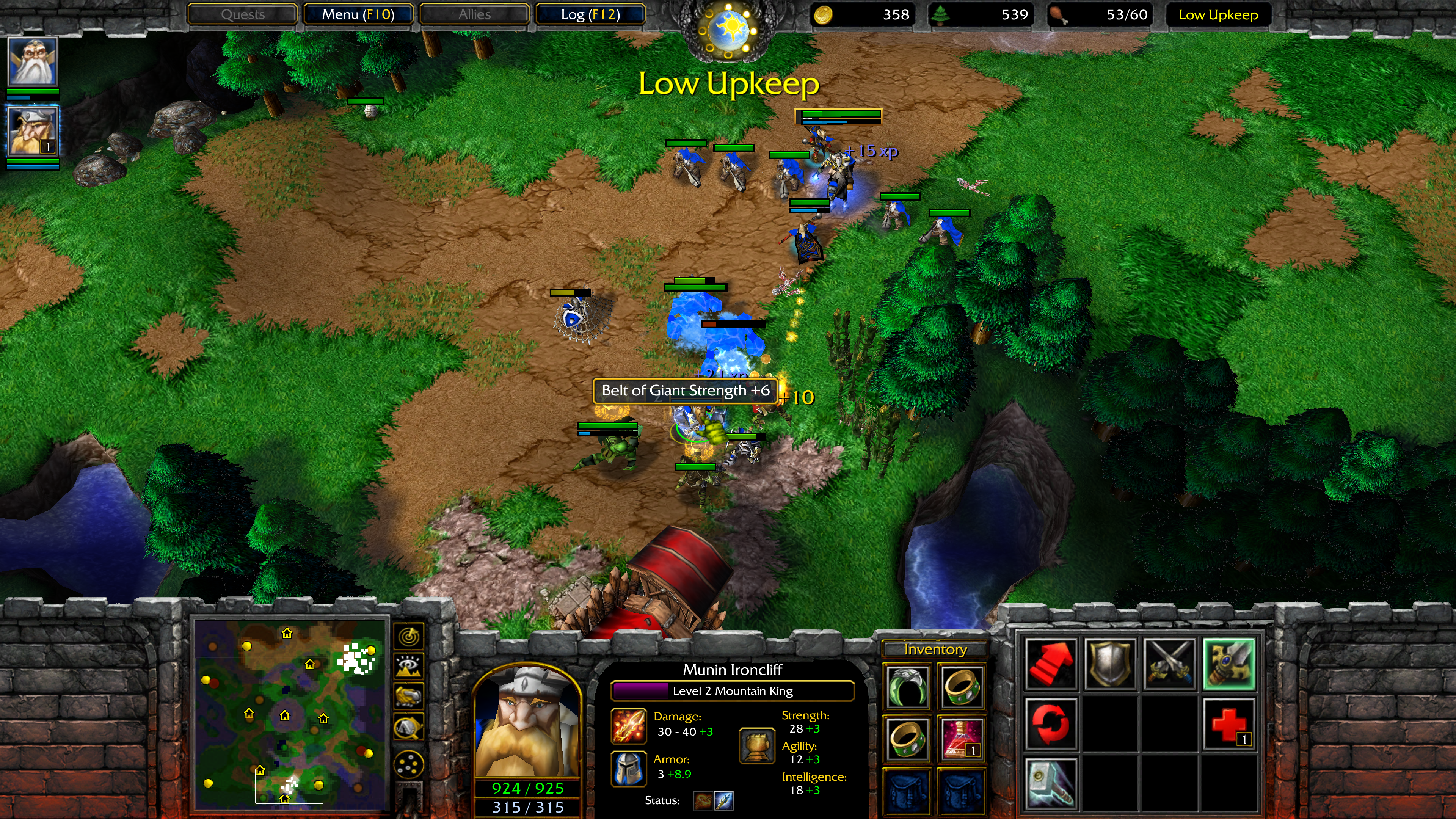
The most important item in the game is the scroll of town portal. It allows a hero to teleport to a selected main building. All nearby allied units will also be teleported. We start the game with a single town portal scroll and can buy more for a steep price of 350 gold.
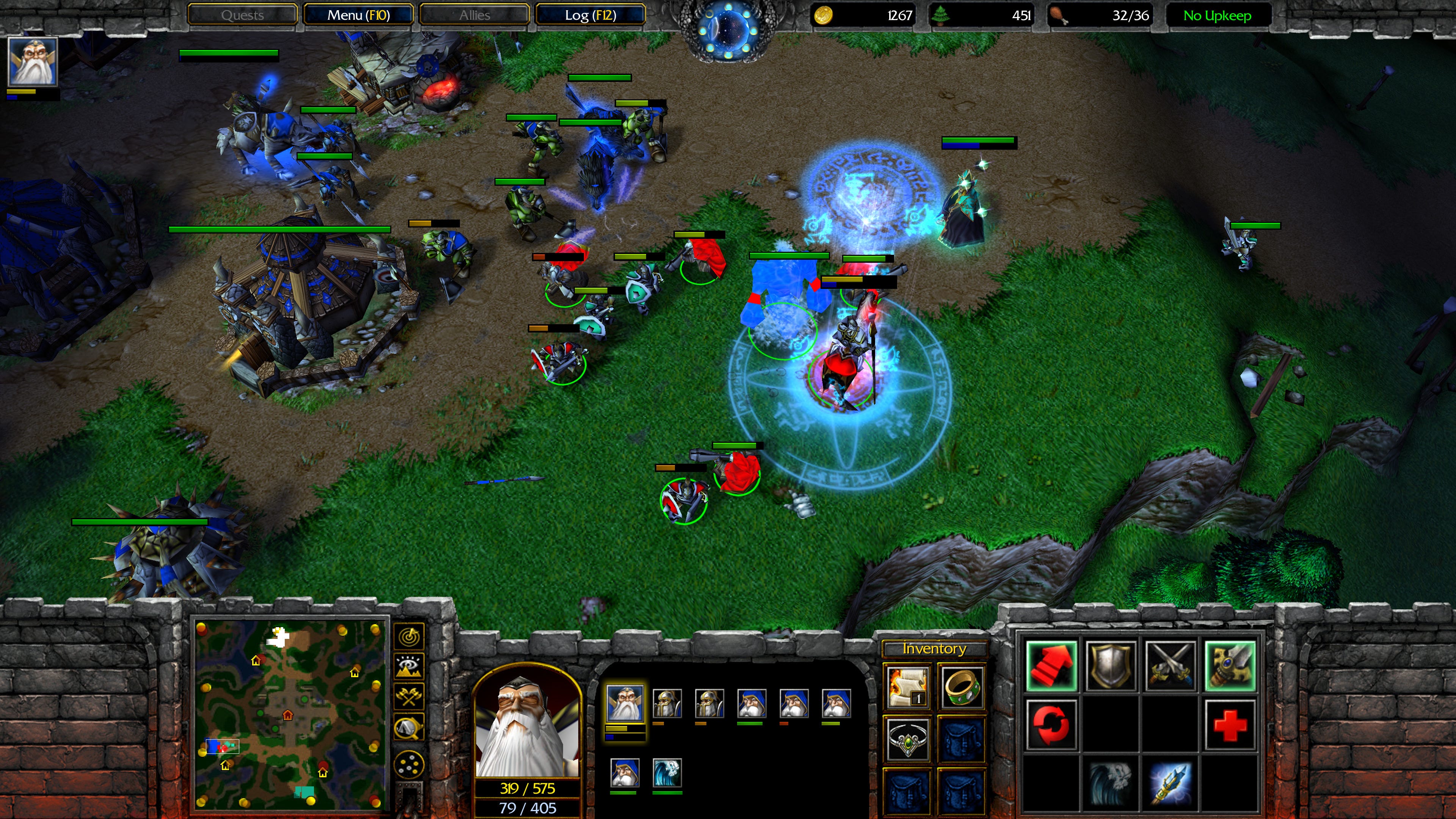
The town portal scroll impacts the gameplay immensely. It makes getting caught out of position much less severe, as we can always exit an unfavorable fight with limited losses. Also, it invalidates the need to keep a lot of defensive troops in our base, as we can always teleport in if the enemy attacks.
However, even though the teleport scroll is very powerful, it doesn’t make positioning and scouting meaningless. The scrolls are too expensive to just rebuy constantly. As the teleport isn’t instant and the enemy knows that we’re trying to teleport in thanks to an indicator on the main building, he can easily withdraw and avoid fighting us. In that case, we’ve effectively wasted 350 gold.
Sure, we have thwarted our enemy’s plans for now, but we also had to interrupt our own to teleport back. Smart enemies will bait teleports to deny us resources and to interrupt our plans. They might send a small amount of units into our base and force us to choose between walking back and accepting the damage these units can deal in the meantime or to commit to a teleport scroll. Orc raiders are especially good at this, as they can quickly deal a lot of damage to our buildings.
I think the town portal scroll is a neat idea. It fits the idea of a smaller scope and the fact that we roam the map a lot. Without it, we’d be constantly out of position and had to play much more defensively. It also underlines the importance of heroes, as only heroes can use items. Hence, a group of roaming units without a hero has no way to teleport back.
If you want to get an impression on how the game plays on a high level, I highly recommend this match between two Warcraft III legends. It shows how active the early game is, how important the heroes are, and the implications of the town portal scroll.
As we can see, the heroes serve as the lynchpin of the game. Their items and abilities can turn the tide on their own in battle, and bringing them up to their full potential is crucial.
It’s no surprise that individual heroes are also at the center of the game’s campaigns.
Campaign
The base game includes four campaigns, once for each race. In the beginning, only a prologue campaign and the human campaign are unlocked. We unlock the rest one at a time once we complete our current one.
The reason for this is that the campaign’s narratives build on each other. As a result, jumping directly into a later campaign could leave us confused. However, the same was true for StarCraft as well, and there it was no problem at all to start with the “last” campaign if we felt like it. I prefer StarCraft’s way, as having to play the campaigns in order can be tedious.
The main reason for this is that the missions are very narratively driven. Warcraft III was Blizzard’s first 3D game, and the team clearly loved the ability to create in-game cutscenes. The game is filled to the brim with them. Mostly, they focus on two characters talking, but some are more eventful. The 3D engine also allowed scripts to modify the terrain. For example, this is used in a mission to destroy a bridge after a dramatic cutscene.
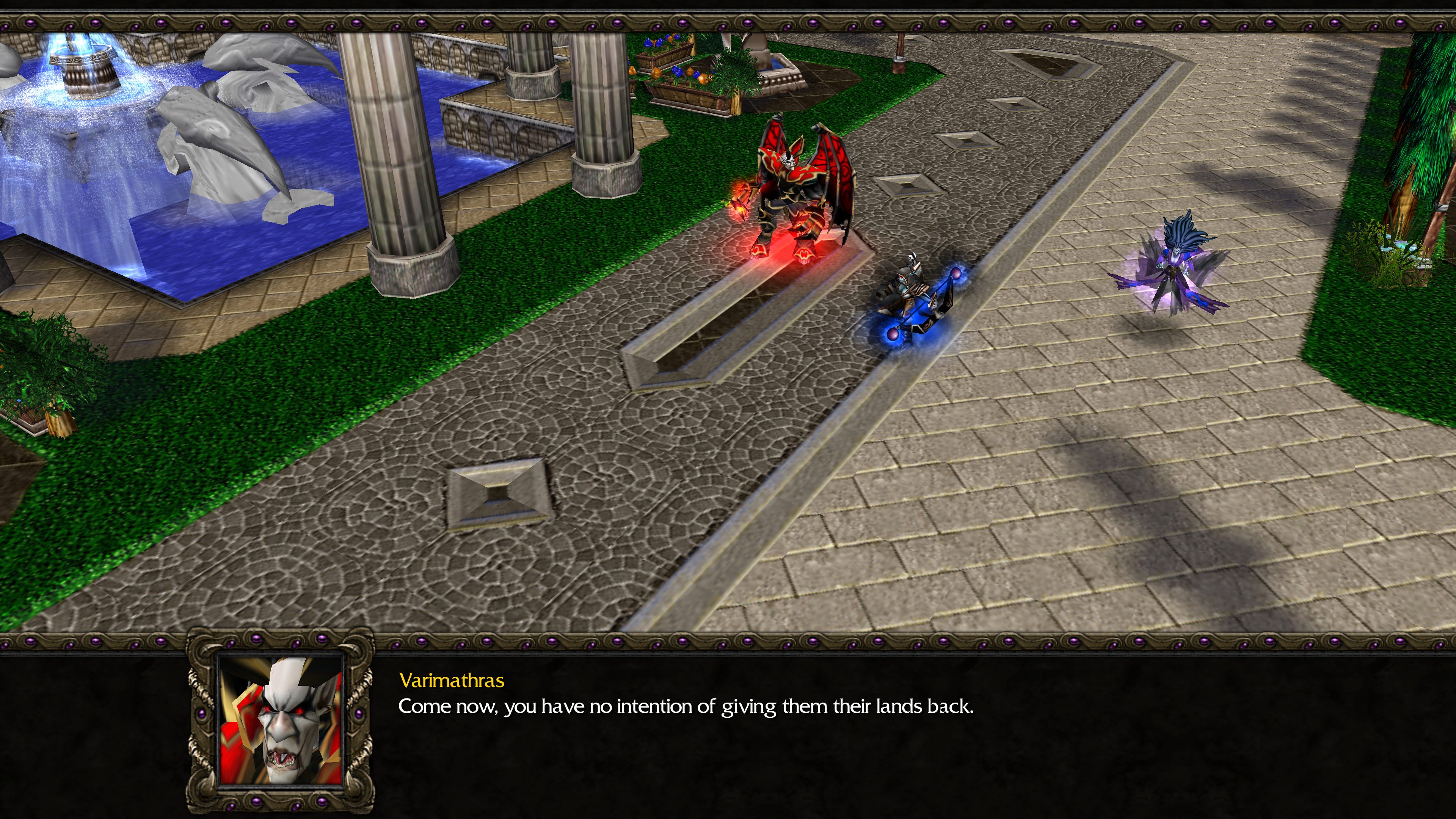
All of this was quite impressive back in the day and rather innovative for an RTS game. In the 90s, RTS chiefly told their stories in between missions, either via videos or animated briefings. Warcraft III moved most of the storytelling into the missions and also used the missions more as a means to drive the story.
As a result, the gameplay in the campaign is quite different from the way the game is played in multiplayer. While there are a couple of missions where we freshly construct a base, more often we already start with a partially constructed one and only put in a couple of finishing touches. There are also a lot of missions where we don’t have any base at all.
We cannot freely recruit heroes in the campaign. This makes sense, as the heroes are deeply interconnected with the narrative. However, we also cannot level the heroes as quickly as usual. Instead, we can usually only gain a single level per mission.
This is indicative of a bigger problem: the RPG elements don’t work well in the campaign setting. Creeping is a nonfactor, as we can easily gain our single level per mission. Items are unimportant as well, as the missions don’t require our heroes to be powerful. It also doesn’t help that some items exclusive to the campaign are ridiculously underpowered.
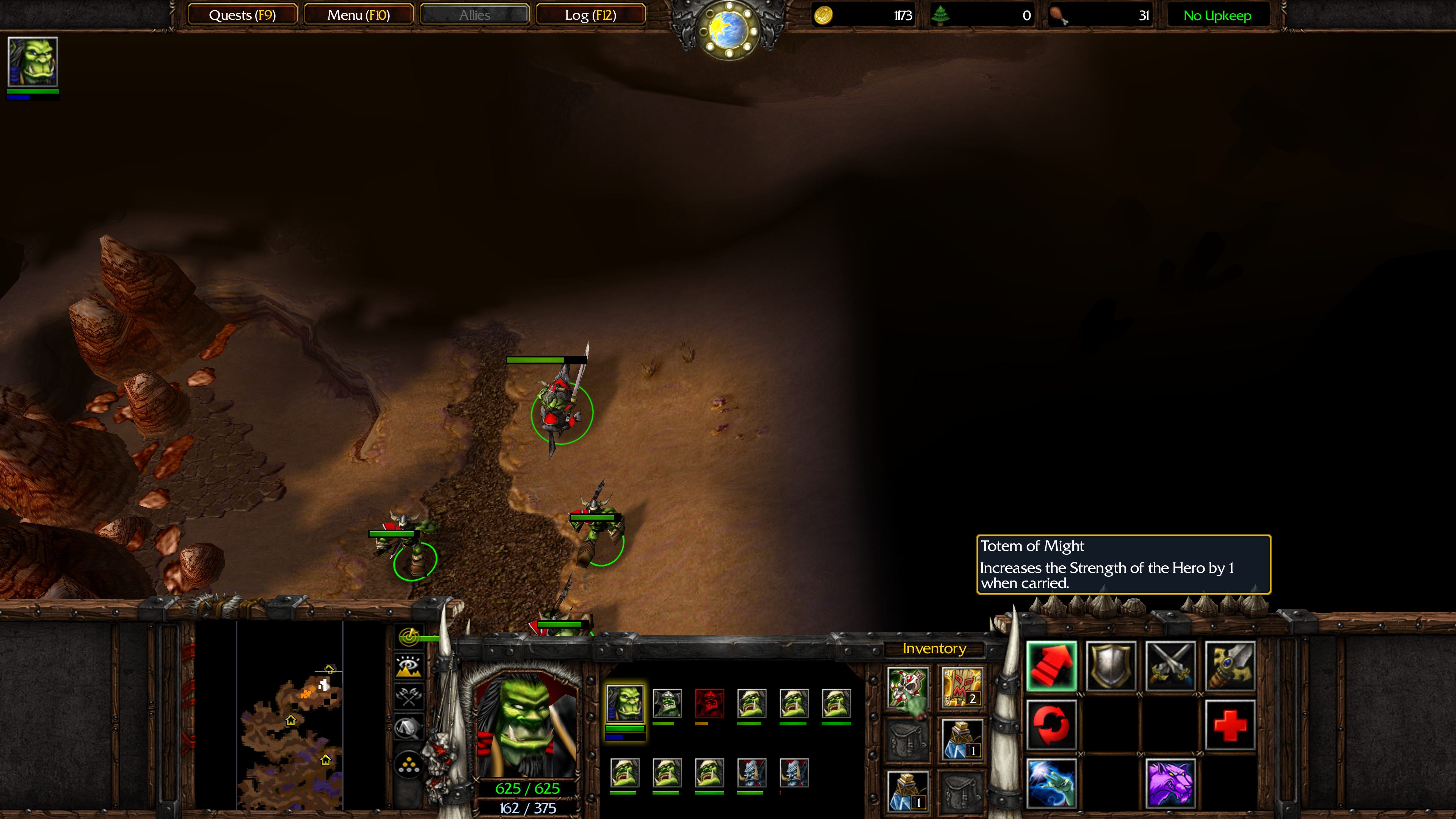
As a result, the elegant fusion of RPG and RTS gameplay is barely visible in the campaign. The difference to how the game is played in multiplayer mode is staggering. Completing the campaign doesn’t prepare us at all for playing the actual game. This is a general problem in RTS games, but it’s exceptionally severe here.
Blizzard clearly prioritized the campaign as a way to tell a story. While the gameplay isn’t bad per se, it’s a lot less fun than just playing skirmish or multiplayer. Replaying the campaign is also quite tiresome, as we get interrupted by cutscenes all the time. This is the main reason why I’ve only replayed Warcraft III’s campaign a couple of times while I’ve replayed StarCraft’s countless times.
The game’s story centers around a demonic invasion of Azeroth. It’s fine and at the time was considered very good for RTS standards. I can’t remember how I felt about it back in the day, but today I find it difficult to care about any of the characters. That’s not very surprising, as writing was never Blizzard’s strong suite. All in all, the story isn’t the problem; rather, it’s the focus on storytelling over gameplay that holds the campaign back.
This problem is even worse in the game’s add-on. “The Frozen Throne” (TFT) adds three more campaigns plus a small bonus campaign. Again, the gameplay has almost nothing in common with the skirmish one. While there are some cool mission ideas, overall, it’s quite tedious.
All in all, I think that the campaigns are good but nothing more. At the time of the release, Warcraft III’s campaigns were extremely well received and praised as the best thing to ever happen to the RTS genre. I think that these glowing reviews were overly optimistic and chiefly motivated by the game’s bombastic presentation. Today, the campaign is much less impressive.
Speaking of the game’s release: Blizzard also had a lot of trouble balancing the game properly.
Balance Issues
When Warcraft III came out, I jumped directly into the multiplayer mode. Blizzard’s Battle.net platform was highly advanced for the time. Being a veteran of StarCraft, I knew that I was in for a good time. What I hadn’t factored in were the balance issues.
There’s no way to sugarcoat it: on release, Warcraft III was highly unbalanced. I’m not sure what kind of testing Blizzard did, but it clearly was insufficient. Players quickly figured out how to exploit what Blizzard missed.
For example, humans loved to abuse the synergy between the Archmage’s mana regeneration-boosting brilliance aura and their spellcaster units. In fact, human armies consisted of only spellcasters! Adding other units simply didn’t make sense as the spellcasters had a decent damage output and could spam their powerful spells. This invalidated the vast majority of other human units.
Blizzard spent months trying to fix the system. They had to completely overhaul the game’s armor system to combat spellcaster spam. At the time, the game had been out for almost a year, and Blizzard had spent the time playing whack-a-mole with the current most broken strategy.
Fortunately, they had an ace up their sleeve: the game’s add-on. With TFT they added an additional hero type for each race as well as a couple of units. They also introduced constructable item shops that addressed a lot of early game issues. The add-on was a big step forward, and with it plus further patching, the game stabilized.
The reason why balancing Warcraft III was so hard are the big number of moving parts. In addition to heroes and units, Blizzard also had to balance the items, item drops, and the creeps of each map. Hence, map design is an even bigger factor in Warcraft III than in StarCraft.
In the end, the game stabilized on a well-balanced level. However, the game never quite achieved perfection. Some strategies were overpowered for years before Blizzard finally stepped in. For example, the critical strike ability of the Blade Master was devastating with the right item drops until Blizzard finally nerfed it.
They also never managed to make all heroes even close to equally powerful. Most races have a preferred hero type that’s the right choice in the vast majority of cases. More variety would’ve been nice.
All things considered, the team did a very good job. Given the game’s difficult development phase, I think some balance issues were to be expected. Fortunately, they didn’t harm the game’s reception.
Reception and Legacy
Both critics and players loved Warcraft III when it came out. It got glowing reviews, especially for its graphics, story, and presentation. Typical for Blizzard, the game features cinematics that were simply stunning at the time (and still look decent today).
In terms of sales, the game was a smash hit. It sold one million copies in the first month of release. That made it the fastest-selling PC video game in history at that time, snatching the title from Diablo II. In total, around four million copies were sold worldwide.
Warcraft III became a multiplayer hit, even though it never reached the popularity of StarCraft. In addition to its great regular gameplay, the game also supported user-created maps with special rules. These so-called “fun maps” were incredibly popular and creative.
Examples for fun maps are minigame collections like Uther Party, tower defenses, and RPG maps. The most important fun map, however, was DotA. What started as a fun map for Warcraft III spawned the MOBA genre and quickly eclipsed its origin.
Today, MOBAs are much more important than classic RTS games. It seems that Warcraft III has accidentally played a role in the decline of its genre.
Warcraft III remains the last entry in the venerable Warcraft series. However, Blizzard continued the games’ storyline in World of Warcraft. Currently, there are no signs that Warcraft IV is even a possibility. Since StarCraft II, Blizzard seems to have given up on the RTS genre.
However, Warcraft III did receive a remaster called “Warcraft III: Reforged” in 2020. It was a total disaster and has changed the game for the worse, even for players who didn’t buy it. It took Blizzard six years to finally restore the option to get an untainted version of Warcraft III from their servers. This nicely illustrates how unimportant Warcraft III has become to them.
Conclusion
Warcraft III is a fantastic fusion of RPG and RTS elements. It’s my favorite RTS of all time and has aged gracefully. In case you missed the game back in the day, you should definitely take a look.
Sadly, there is no way to buy the original version of the game anymore. Instead, we have to buy Reforged for a ridiculous price of $30 (USD). At least, this also grants us access to the original version of the game, which is the one I’d recommend.
However, it’s difficult to replicate the multiplayer experience so long after release. While the multiplayer scene is still around, it’s obviously much smaller than at its peak. Also, the average skill level is quite high, as the scene chiefly consists of veterans. This makes it quite difficult to get into the game.
I’m grateful that I had the chance to experience Warcraft III’s multiplayer in its heyday. It’s quite sad that younger players cannot experience this as well. Blizzard did their part in making it even harder by dismantling the old server infrastructure and replacing it with an inferior one. Warcraft III deserved better.
Thanks for reading. Please consider subscribing to the Substack. Also, please share it with a friend. You can do both with these handy buttons below.
Warcraft 3 is peak gaming. The fact that it spawned a new genre of MOBA and Blizzard having to update the terms of service for map editor to own everything showed how impactful the game was. Though there were limited choices back then -not sure if modern games can reach that level of impact.
You’ve undersold yourself! This isn’t just a review, it’s a retrospective! Really great recap of the history of them game, and a great read. Thanks for writing!