
Hotline Miami Review
Do you like hurting other people?

My love for video games has waxed and waned over the last twenty years. While I’m still quite dissatisfied with the current state of affairs, it’s undeniable that some remarkable games have revitalized my love. One of them is Ghostrunner, which I discussed in my first proper post on this Substack. The other is today’s topic, Hotline Miami.
Hotline Miami is a 2D top-down action game. It was released in 2012 and developed by just two developers, Jonatan Söderström and Dennis Wedin. The game is set in an alternative version of Miami in 1989. The city has a sizable population of Russian mobsters, and our goal is to rectify this problem. At least this is what we think the weird messages left on our answering machine tell us.
Gameplay
To rid the city of the mob problem, we rely on both melee and ranged combat. While we (usually) start the level unarmed, our numerous enemies will supply us with all the weapons we could ever need. We just need to knock them unconscious first. While our fists only stun enemies, all other weapons in the game kill (most) enemies with one hit. However, the same applies to us. The result is a highly intense game where dying is very common.
Fortunately, respawns are super quick, and we don’t have to finish the whole level in one go. Instead, a level is comprised of multiple floors, and reaching a new floor serves as a checkpoint. This lenience is badly needed as Hotline: Miami is very fast-paced and there is very little room for error. While the levels are very compact and usually easy to grasp, it takes a couple of attempts to figure out the proper route for each floor. Failure is part of the process.
We can further customize our gameplay experience by choosing between different masks at the start of the level. Each mask (except the first one) has a distinct effect. For example, the unicorn mask (“Peter”) reduces the noise of our shots. This makes the game much easier, as enemies are less likely to gang up on us once we start shooting.
We obtain masks by either reaching sufficiently high scores in certain levels or by finding them within the levels. In addition to the level score, the game also grades our performance at the end of each level (from A+ to F-) and keeps track of our total score. The total score is used to unlock new weapons, while the grades are purely cosmetic. The scoring system is probably a tribute to the game’s arcade design, but for me it doesn’t really add a lot to the game.
While the new masks are cool and can make a difference, the new weapons don’t matter. I was also never motivated to replay levels to improve my grade. That said, I understand that more “highscory” players are motivated by such a system, so it’s nice that it exists. For me, the intense gameplay and the story were more than enough to keep me motivated.
Story
As mentioned, our character receives weird messages on his answering machine. None of these messages actually tell us to kill anyone. For example, we receive a message asking us to fill in as a babysitter for some unruly kids at a certain address. After listening to a message, we leave our apartment, enter our car, and thereby start the next level. After completing a level, there are often short story sequences in which we do ordinary things like picking up a pizza or renting a movie.
These sequences make it clear that the game is an unreliable narrator. In the beginning, everything seems reasonably normal, even though it’s very suspicious that the same bearded man works everywhere we go and that he always tells us that things are on the house.
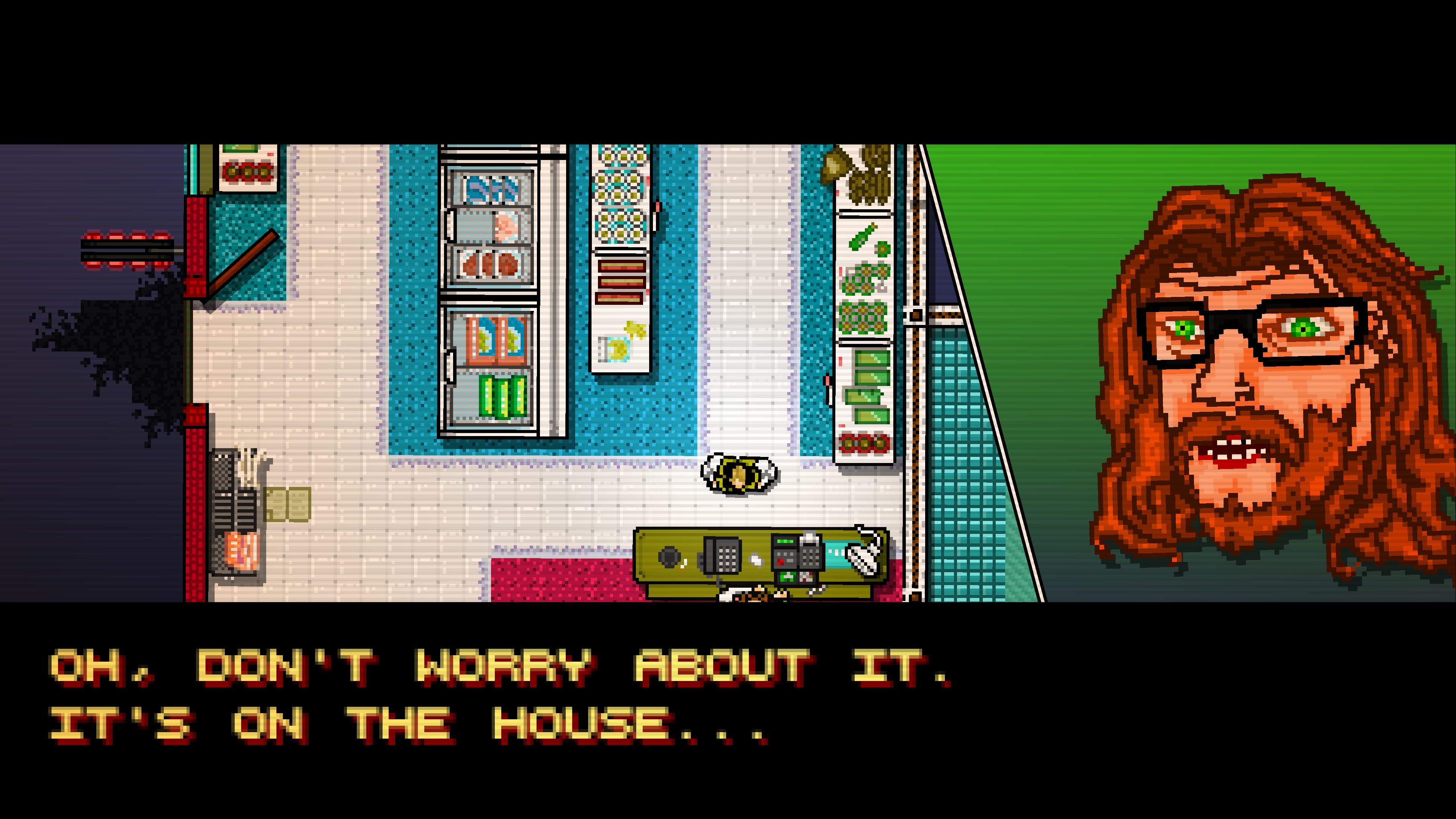
As we progress in the game, we encounter more and more weird things that nobody but us seems to notice.
In addition to these hallucinations, we also have strange dreams between chapters. In those, three masked figures talk to us and ask us weird questions like whether we enjoy hurting other people.
It's clear that the game wants to illustrate that something is not right with our protagonist. He doesn’t know exactly what’s going on, and neither do we as players. While the story is quite cryptic, it does its job and keeps us motivated. After the main story has concluded, we switch to a different character and have a chance to get some answers, provided we picked up the hidden item in each level.
Graphics
As mentioned in the introduction, Hotline Miami is a 2D game. Its pixel art is very colorful and clearly inspired by the 80s. While hardly beautiful, the graphics are easy to read and fit the game’s themes. The game is also extraordinarily bloody. Once we’re done with a level, large parts of the environment are covered in blood.
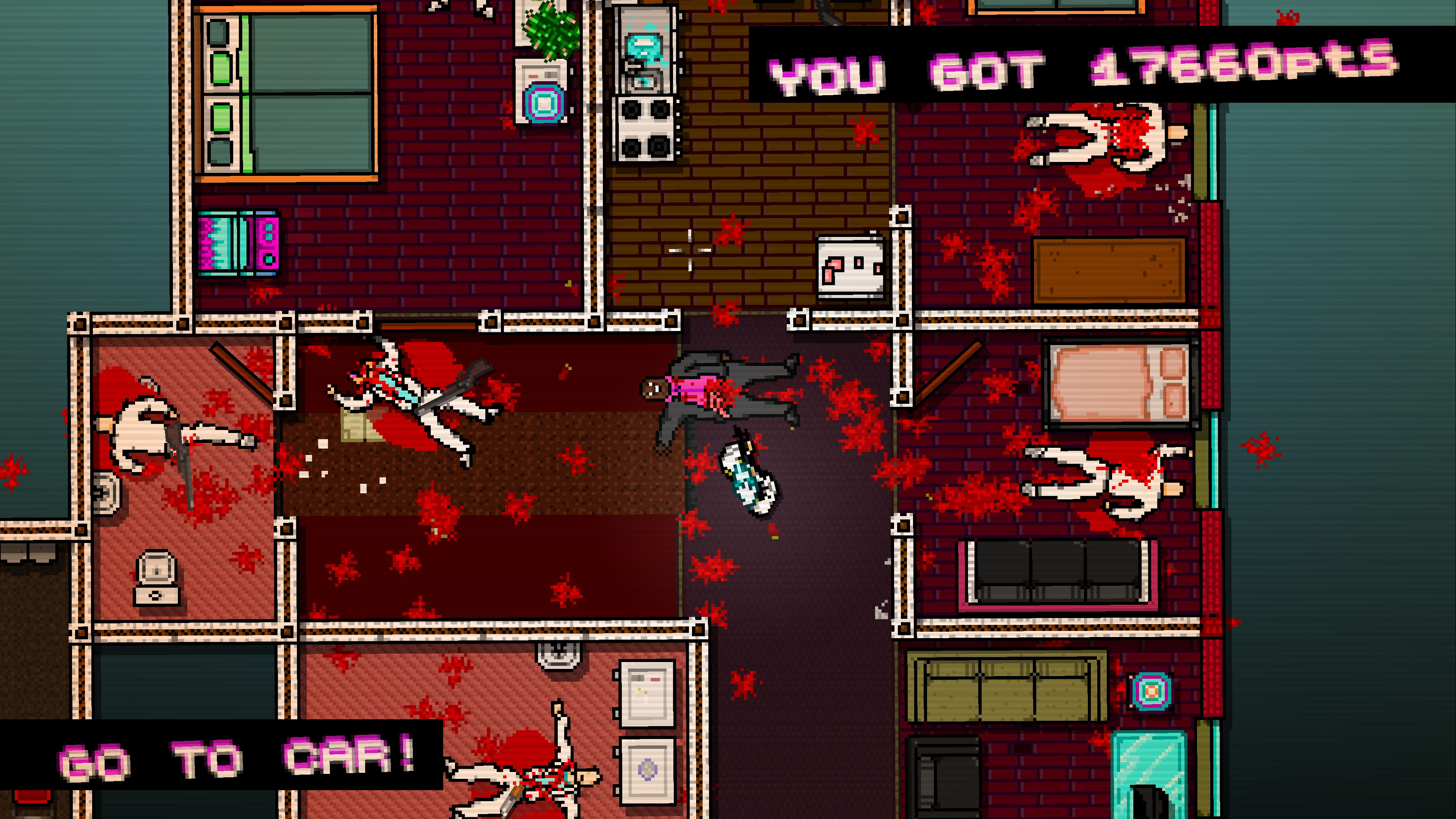
This was an artistic choice by the game creators, who are quite fond of violent movies. While not a gorehound myself, I can see how the ultra-violence fits the tone of the game. It was clearly important to Söderström and Wedin to deliver a cohesive piece of work. This is also evident from the game’s soundtrack.
Music
Hotline Miami is famous for its soundtrack and rightfully so. The developers prioritized finding suitable music for the game and it shows. The mix of techno and synthwave they ended up with fits the game perfectly. It can be pushy, ominous, and upbeat. I especially like M|O|O|N’s contributions. It’s hard to pick a favorite, but I think mine is “Release”.
All in all, I think that the music is a very important part of the game. I don’t think it would’ve been as successful with a weaker soundtrack.
Greatness
After having described the game as well as I can, I still need to answer precisely why I think Hotline Miami is so great. If you’ve read my review of Ghostrunner, some of this will sound familiar, as the two games have similar strengths. Hotline Miami is incredibly dense and intense. There is close to no downtime in the game, and the fragility of our character requires us to stay focused throughout the game. Even back in 2012, this was a rarity for modern games. Hotline Miami feels like a game that escaped from the arcade, mutated for a while, and then made its way back to modern platforms. When I first played it, it felt incredibly refreshing. The game requires minimal effort to get into, is quite difficult to master, and manages to straddle the line between “challenging” and “frustrating” marvelously. It’s also excellent at creating a flow. Once we have figured out how to approach a level, the execution is wonderfully fluid.
In addition, the setting, the presentation, and the general concept felt incredibly innovative back in 2012. While the game is hardly technically outstanding, the whole package feels wonderfully cohesive. It’s clear that this isn’t just a product but something the two developers poured a lot of effort into and held close to their hearts. Hotline Miami is a game that could only come from the indie scene. It showed us that the future of game development lies outside of big companies. As such, it represents a ray of hope to me that video games can still be great, and for that I’ll always carry it in my heart.
Reception
I’m hardly the only one who greatly enjoyed Hotline Miami. The game sold more than 4 million copies and to this day is regarded by some as the gold standard for indie games. Given this much success, it was close to inevitable that the game received a sequel, which was released in 2015.
Sadly, Hotline Miami 2 is inferior to the original in every aspect. It’s held back by a much more open level design, which leads to frequent and frustrating off-screen kills. Also, the story is highly disjointed and uses too many characters. To make things worse, the ending feels like a punch to the gut for every fan of the series. For all these reasons, I recommend ignoring the second game.
As both Söderström and Wedin have left the gaming industry, it’s very unlikely that we’ll ever see a Hotline Miami 3. Given the disappointing quality of the second game maybe that’s for the best.
Conclusion
Hotline Miami is one of my all-time favorite games. Its combination of engaging, dense, and intense gameplay with great music and an interesting story is simply outstanding. If you have any love for action games and for some reason haven’t played it yet, I highly encourage you to check it out.
If you enjoyed this post, please consider subscribing to the Substack. Also, please share it with a friend. You can do both with these handy buttons below.